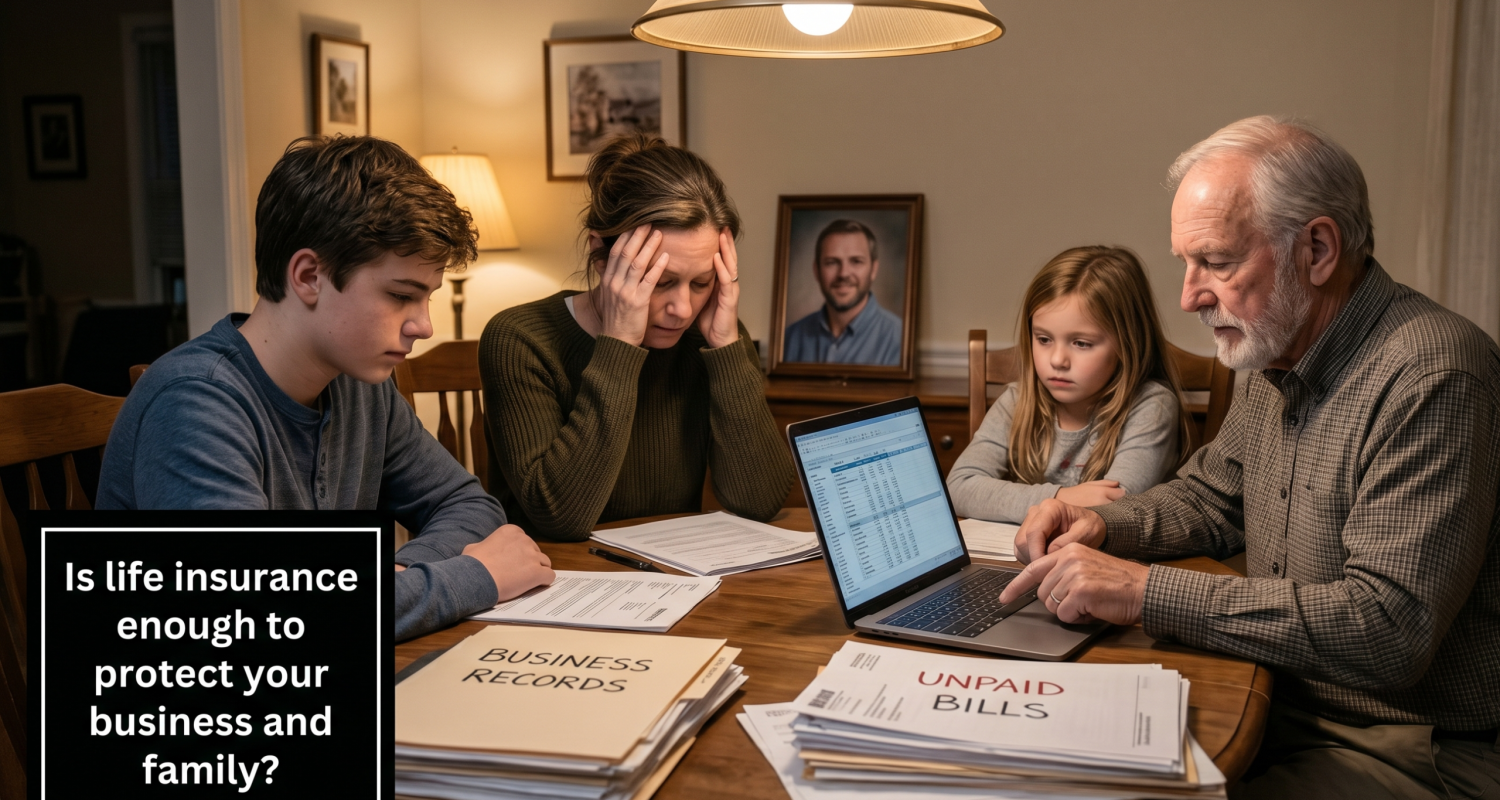
If you own a business, one uncomfortable question matters more than many owners want to admit: what happens to my business if I die without life insurance?
For many families, the business is not just an asset. It is the income source, the financial plan, the debt burden, and sometimes the only thing holding the household together. If the owner dies unexpectedly, the impact can move fast. Payroll may still need to be met. Rent may still be due. Loan obligations do not disappear. Vendors still expect payment. If there are partners, heirs, or key employees involved, confusion can become expensive almost immediately.
This is where life insurance can become far more than a personal financial product. In the right structure, it can help protect the people who depend on you, stabilize the business during a crisis, support a buy-sell agreement, create liquidity when cash flow is tight, and reduce the financial chaos that often follows the death of an owner. At the same time, life insurance is only one part of a broader continuity strategy. Federal emergency-planning guidance emphasizes the importance of business continuity planning, and small business guidance has long highlighted succession and estate-planning risks for owner-led companies.
The real issue is not whether death is likely. The real issue is whether your business could survive the shock.
Why the death of an owner can financially destabilize a business
A lot of small businesses depend heavily on one person. That person may control revenue, relationships, operations, approvals, hiring, banking access, or high-level decisions. In many owner-led businesses, there is no clean separation between the business and the individual running it.
That creates fragility.
If the owner dies, several problems can hit at once:
- revenue slows because customers trusted the owner personally
- internal decisions stall because no one has clear authority
- family members may inherit ownership but not operational knowledge
- partners may want control clarity immediately
- lenders and creditors may still expect regular payments
- employees may panic and begin looking for other jobs
- taxes, legal fees, and estate-related issues can create added pressure
This is especially dangerous when the business has limited cash reserves. A profitable company on paper can still become vulnerable very quickly if it loses leadership, revenue momentum, and decision-making continuity all at once.

What life insurance can actually do for a business
Many people think of life insurance only as money for a surviving spouse or children. That is part of it, but for a business owner, the function can be much broader.
Depending on how the policy is structured, life insurance can help do several things:
1. Replace lost personal income for the family
If your family depends on the income you pull from the business, your death can create two losses at once: the family loses your earnings, and the business may lose its main operator. A life insurance payout can help cover mortgage payments, living expenses, tuition, debts, and everyday survival while the family decides what to do next.
That matters because families often make poor business decisions when they are grieving and financially cornered at the same time.
2. Create short-term liquidity for the business
A business may need immediate cash after the owner’s death. It may need money to keep operations going, retain staff, pay vendors, calm creditors, or buy time while a transition plan is activated.
Without liquidity, businesses are often forced into bad decisions:
- rushed asset sales
- desperate borrowing
- layoffs
- operational shutdowns
- partner disputes
- selling the company under pressure instead of from strength
Life insurance can provide breathing room when timing matters most.
3. Fund a buy-sell agreement between owners
If a business has multiple owners, one of the biggest risks is what happens to ownership when one of them dies. The surviving owners may want to buy the deceased owner’s share, but they may not have enough cash to do it. Meanwhile, the deceased owner’s family may want money, not an unclear ownership stake in a business they do not know how to run.
That is one reason buy-sell planning matters. In practice, life insurance is often used to help fund these arrangements so surviving owners can buy the deceased owner’s interest instead of leaving the matter unresolved. The exact tax and legal treatment can vary, and the structure should be reviewed carefully with qualified professionals, but the planning purpose is clear: life insurance can help turn a crisis into an orderly ownership transition. IRS guidance also addresses situations involving employer-owned life insurance, including notice and consent requirements that may affect business-related policies.
4. Protect the business from the loss of a key person
Sometimes the person who dies is not the sole owner, but they are still essential to the business. They may be the main rainmaker, operator, chef, manager, strategist, or client-facing leader. In these cases, a business may use life insurance as key person insurance to help absorb the financial shock caused by that loss.
The goal is not emotional. It is operational.
The money may be used to:
- stabilize cash flow
- hire a replacement
- protect lender confidence
- reassure investors or partners
- support transition costs
- keep the company alive long enough to recover
For many businesses, losing the wrong person can be just as dangerous as losing the owner.
What happens if you have no life insurance at all
If there is no life insurance, the pressure lands somewhere else.
Usually that means one or more of the following:
Your family absorbs the shock personally
If your family depends on the business income and there is no benefit payout, they may be forced to rely on savings, sell assets, take on debt, or liquidate the business quickly. That can be financially devastating, especially if they are also dealing with funeral costs, legal expenses, or unpaid business obligations.
The business becomes a forced sale candidate
A business without cash, planning, or leadership continuity often becomes vulnerable to a distressed sale. Instead of selling on favorable terms, the family or surviving stakeholders may accept whatever they can get because time is against them.
Ownership disputes become more likely
If there are multiple owners, no funded transition plan, and no clear mechanism to transfer ownership, conflict can emerge fast. The family may think the business is worth more than the surviving owners believe. The surviving owners may feel trapped. Employees may see instability. Customers may sense risk. The damage can spread quickly.
Debt becomes more dangerous
Business loans, personal guarantees, operating debt, equipment financing, credit lines, and lease obligations can all become more painful after the death of an owner. Without liquidity, even a business with strong long-term potential can be cornered by short-term financial pressure.

Life insurance is not the whole plan, but it can be one of the most important parts
A lot of owners make one of two mistakes.
The first mistake is having no life insurance at all.
The second is believing that simply owning a policy means the business is protected.
It does not.
Life insurance works best when it is part of a broader continuity strategy that includes:
- a business continuity plan
- clear succession instructions
- documented access to accounts and key records
- buy-sell agreements if there are multiple owners
- updated beneficiary designations
- legal and tax review
- operational backup plans for leadership loss
Business continuity guidance from Ready.gov stresses that businesses should organize continuity planning and prepare for disruption before a crisis happens. That logic applies to the death of an owner too. A company can survive many shocks more effectively when responsibilities, authority, and recovery actions are documented in advance.
Does term life or permanent life insurance make more sense for business owners?
There is no universal answer, but there are patterns.
The National Association of Insurance Commissioners explains that term insurance generally has lower premiums in earlier years, while cash value policies such as whole life or universal life can stay in force longer and may include savings or investment-related features.
In practical terms:
Term life insurance may make sense if:
- you want a more affordable option
- you need protection during your highest-risk financial years
- you want coverage tied to debts, children, or business loans
- you need coverage while the business is still growing
Permanent life insurance may make sense if:
- you want long-term coverage that does not expire after a fixed term
- you are thinking about estate planning or legacy planning
- you want a policy that can build cash value over time
- you are using the policy as part of a more advanced planning structure
The right answer depends on your goals, your cash flow, your family obligations, your business structure, and what you are trying to protect.
When business owners are most exposed
Some owners are more vulnerable than others. The risk is usually higher when:
- the owner is the main producer of revenue
- the business has debt or tight margins
- there is no succession plan
- the spouse or family is not involved in operations
- there are multiple owners but no funded buy-sell arrangement
- there is a key employee whose loss would seriously damage the company
- the business depends on one location, one relationship network, or one operator’s expertise
In other words, if the business depends heavily on a person, then the death of that person is a business risk, not just a family tragedy.
Questions every owner should ask now
If you are a business owner, here are the questions worth asking before a crisis happens:
- If I die this year, who can legally and practically run this business next week?
- Would my family receive enough money fast enough to avoid panic decisions?
- Would my partners have the cash to buy my ownership share?
- Do we have a written plan for continuity, authority, and access?
- Would the business survive 30 to 90 days without me?
- Are my beneficiaries, agreements, and records actually up to date?
Many owners do not avoid these questions because they are irresponsible. They avoid them because the topic is emotionally heavy. But delay has a cost. The longer the planning waits, the more likely your family or business will pay the price later.

Life insurance can protect more than money
For business owners, life insurance is not only about replacing income. It is often about preserving options.
Options matter.
With enough liquidity, a family can avoid a rushed sale.
With funded planning, partners can avoid conflict.
With transition support, employees can keep their jobs.
With continuity, the business has a chance to survive your absence rather than collapse under it.
That is the deeper value.
A business may still suffer after the death of an owner. Life insurance does not remove grief, and it does not solve every legal or operational problem. But it can reduce financial chaos, buy time, protect people, and make it possible for the business to move forward with more stability.
The real question is not whether you need life insurance
The real question is what would happen without it.
If your family relies on your income, if your business depends on your leadership, if your partners need an exit mechanism, or if your company would struggle to survive your absence, then life insurance is not a side issue. It is part of responsible business planning.
For many owners, the most dangerous assumption is not “I will die soon.”
It is “things will somehow work themselves out.”
They often do not.
And when they do not, the cost is paid by the people left behind.