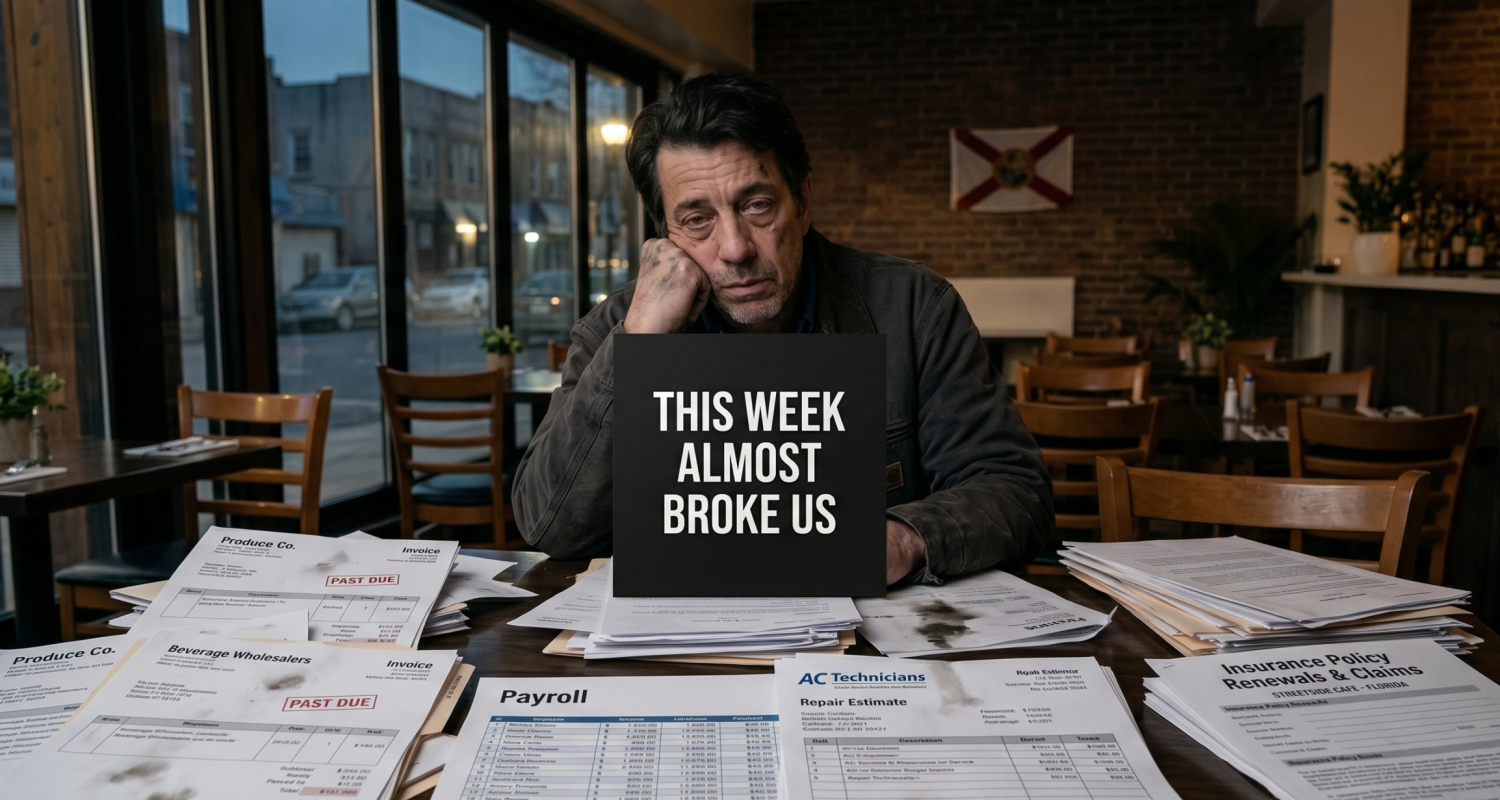
The week I realized my restaurant could go bankrupt did not begin with one dramatic explosion.
There was no fire. No viral scandal. No single moment where everything collapsed in public.
What happened was worse in a quieter way. Several problems hit at the same time, and for the first time, I understood that a restaurant usually does not fail because of one cinematic disaster. It starts failing when the business is already stretched, a few things go wrong at once, and the owner realizes there is no room left to absorb the shock.
That is why this story matters.
CIS already says something very close to this in what should a restaurant do to avoid bankruptcy. The article argues that restaurants usually do not go bankrupt because of one bad night. They fail when cash flow, costs, risk, and operations are ignored for too long. (usa-cis.com)
That sentence hits harder when you have lived the week where it starts feeling true.
Because the moment that scares you is not always “we are bankrupt.”
The real moment is “I can finally see how it could happen.”
It started like a normal hard week
If I were telling this the way many restaurant owners would actually tell it, it would start like this:
We had already been under pressure for months. Food costs were higher. Labor never really felt stable. Insurance was another expense I paid, but not one I wanted to think about deeply. We were still operating, still serving, still pushing through. So I kept telling myself the same thing owners tell themselves all the time: if we stay busy, we will be fine.
Then came the week that exposed how thin “fine” really was.
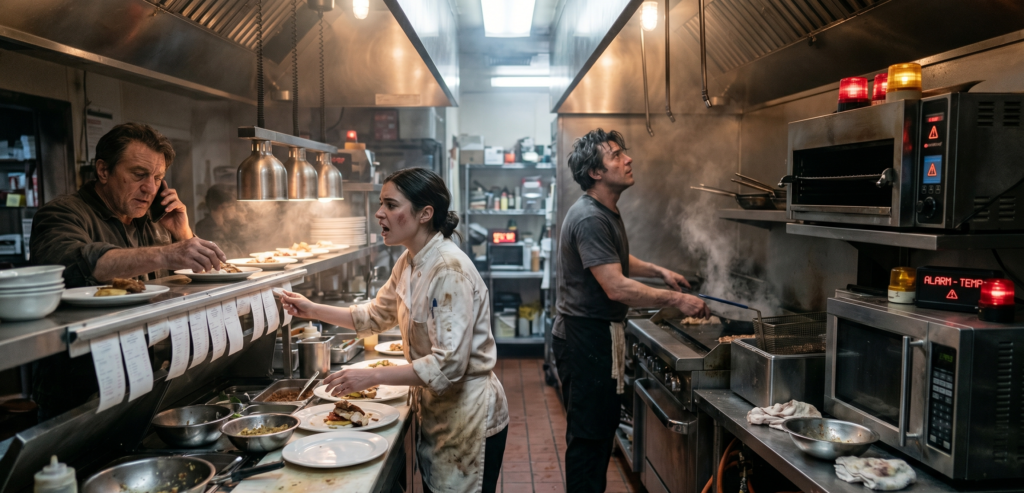
One equipment problem delayed service. One staffing problem forced the rest of the team to rush. A few orders went wrong. A customer issue pulled management attention away from the floor. Revenue still came in, but the business felt like it was leaking from five places at once.
Nothing looked apocalyptic from outside.
Inside, it felt like margin death.
That is one reason this story is stronger than a generic advice article. It captures what owners often miss: restaurants do not usually collapse all at once. They become fragile first.
The industry context makes this story more believable, not less
This is not just personal drama. The broader industry data supports the pressure many owners feel right now.
The State of the Restaurant Industry 2026 says rising costs remain the industry’s key stressor, and 42 percent of operators reported their restaurant was not profitable last year. (restaurant.org) That is not a fringe number. It means a large share of restaurant owners are operating in an environment where survival is not only about demand. It is about whether the business can still hold together under cost pressure.
That matters because many owners confuse sales activity with stability. A restaurant can still look alive while becoming financially weaker.
Busy does not always mean safe.
Open does not always mean healthy.
A full dining room does not automatically mean the business can absorb one bad week.
The week felt expensive before it felt dangerous
That is an important distinction.
At first, the week did not feel like bankruptcy. It just felt expensive.
A refrigeration issue created stress around product. A payroll obligation hit at the wrong time. A manager had to step into too many gaps. One customer issue became a bigger interruption than it should have. One delay created another. And suddenly the business was not only working hard. It was working hard while bleeding attention, time, and money.
That is often how financial danger enters a restaurant.
Not as one huge invoice.
As stacked disruption.
CIS’s why is my restaurant insurance getting so expensive in Florida? makes a related point from the insurance side. The article says restaurant risk is layered because restaurants combine public traffic, employee injury exposure, property risk, equipment dependence, cyber exposure, and interruption sensitivity in one business model. (usa-cis.com)
In other words, the business is not fragile because owners are weak. It is fragile because restaurants are complicated machines with small margins for error.
The most painful moment was realizing how many problems were connected
This is the part owners often see too late.
During that week, each problem looked separate at first:
- one equipment problem
- one staffing problem
- one customer complaint
- one operational delay
- one cash flow strain
But they were not separate. They were feeding each other.
When equipment slows down, service gets worse.
When service gets worse, staff stress rises.
When staff stress rises, mistakes multiply.
When mistakes multiply, management gets pulled off the strategic work.
When management gets pulled off the strategic work, money problems get less attention at exactly the wrong time.
That is why key questions for reviewing your restaurant insurance plan matters so much in this kind of story. It is built around the idea that owners should ask hard questions before weak points line up into something more serious. (usa-cis.com)
The week I realized my restaurant could go bankrupt was really the week I realized I had been treating connected risks like isolated annoyances.
Cash flow panic changes the way everything feels
One of the ugliest truths in restaurant ownership is that once cash flow starts feeling tight, every ordinary problem becomes emotionally louder.
A spill is not just a spill. It is another interruption.
An employee calling out is not just a scheduling issue. It is another strain.
A delayed repair is not just frustrating. It is a threat.
A customer complaint is not just unpleasant. It is one more thing the business cannot afford.
This is where the story becomes honest.
The owner is not only afraid of “bankruptcy” in the abstract. The owner is afraid because the business no longer feels resilient. The restaurant starts to feel like something that might survive a perfect week but not a messy one.
CIS captures that broader fear very well in restaurant business insurance: essential coverage for startup restaurants, where the article explains that restaurants in Florida face a range of exposures that can damage a business before it becomes mature enough to absorb them comfortably. (usa-cis.com)
And even if your restaurant is not a startup, the logic still holds. A business without enough room to absorb disruption is living closer to crisis than it may admit.
Underinsurance feels abstract until the wrong week arrives
This is another place where the story needs to stay sharp.
A lot of owners do not think of underinsurance as a dramatic mistake. They think of it as something that might matter someday, maybe, if something big happens.
But the week I realized my restaurant could go bankrupt, I stopped thinking about insurance as a future problem. I started thinking about it as a present question: if this gets worse, are we actually protected where it matters, or have I just been paying for a policy without understanding the real gaps?
That is where restaurant and entertainment insurance becomes more than a service page. CIS’s restaurant page shows exactly how layered restaurant exposure is: general liability, property, workers’ compensation, cyber liability, equipment breakdown, and more. (usa-cis.com)
The problem is that many owners only feel the importance of layered coverage when one bad week reveals how many things can go wrong without qualifying as one giant disaster.
Equipment failure is not just a maintenance issue
This was part of the wake-up call too.
A lot of owners think about equipment as a repair problem. But in a restaurant, equipment failure is often a revenue, staffing, service, and spoilage problem at the same time.
If refrigeration fails, the issue is not only the machine.
It is product loss, timing pressure, possible menu disruption, staff stress, guest dissatisfaction, and cash flow strain.
That is exactly why CIS includes equipment breakdown insurance in its broader restaurant coverage framework. The category exists because equipment problems can become business problems very fast. (usa-cis.com)
During a weak week, that distinction becomes brutally clear.
The machine is broken.
But what you really feel is that the operation is getting weaker by the hour.
A bad week also reveals how tired the management system really is
This is one of the least discussed parts of restaurant fragility.
The business may look like it is held together by systems. In reality, many restaurants are held together by exhausted managers improvising constantly.
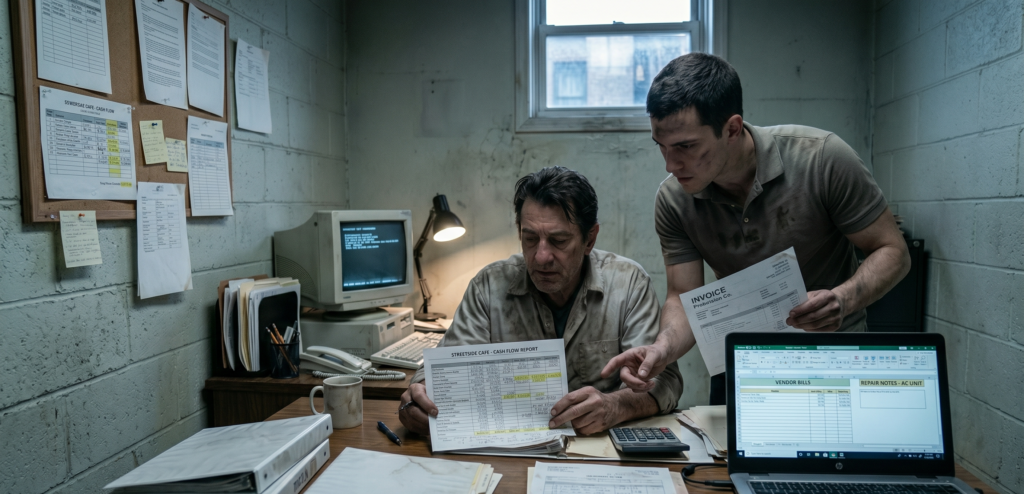
During the week I realized my restaurant could go bankrupt, what scared me most was not only the numbers. It was seeing how much of the business depended on management covering cracks manually:
- solving scheduling gaps
- calming guests
- answering staff confusion
- checking vendors
- handling repairs
- reviewing bills
- making judgment calls under pressure
That kind of management heroism can keep a restaurant alive temporarily. But it is not the same thing as a resilient business.
This is one reason CIS’s broader safety and preparedness content matters. The National Restaurant Association’s preparedness material Always Ready: Natural Disasters is framed around planning before disruption, not improvising after the fact. (restaurant.org) The same logic applies to financial and operational pressure. A business that survives only because managers are overextending themselves is already showing weakness.
Bankruptcy usually appears first as a chain of smaller losses
This may be the most important sentence in the article.
Bankruptcy usually appears first as a chain of smaller losses.
Not only financial losses.
Operational losses.
Energy losses.
Attention losses.
Trust losses.
Time losses.
That is why the story matters so much. It corrects a false image many owners have in their heads. They imagine bankruptcy as a formal legal endpoint. But psychologically, owners feel it much earlier. They feel it the week they realize the restaurant cannot keep absorbing friction without something deeper breaking.
CIS gets close to that idea in what should a restaurant do to avoid bankruptcy, but the storytelling angle makes it easier to feel: the danger enters the room before the official word ever does. (usa-cis.com)
What I should have been asking before that week
If this story has a useful lesson, it is not just “bad weeks happen.”
It is that I should have been asking better questions before the week arrived:
- If one key system failed, how much cash pressure would that create?
- If staff stress rose suddenly, would service quality collapse fast?
- If a customer problem turned into a claim, would we know what to do?
- If a closure or interruption lasted longer than expected, how exposed would we be?
- Does our current restaurant and entertainment insurance structure actually match the operation we run now?
- Have we reviewed the business honestly, or only renewed the paperwork?
That is why key questions for reviewing your restaurant insurance plan belongs naturally inside this piece. It is one of the clearest CIS articles for owners who need to stop operating on assumption. (usa-cis.com)

This is not only about fear. It is about clarity.
I do not think the right message here is “you should panic.”
The right message is “you should stop romanticizing how much stress the business can absorb.”
Restaurant owners are often strong enough to survive chaos for a long time. That can become its own problem. The stronger the owner is psychologically, the easier it becomes to normalize a business that is quietly becoming unstable.
That is what this story cuts through.
The week I realized my restaurant could go bankrupt was not the week everything ended.
It was the week I lost the illusion that staying open automatically meant staying safe.
Where this fits inside the CIS content system
This article should connect naturally to several CIS pages because it sits at the intersection of financial pressure, operational fragility, and insurance review.
It belongs next to what should a restaurant do to avoid bankruptcy because it gives that practical article a human, first-person emotional frame. It belongs next to why is my restaurant insurance getting so expensive in Florida? because that piece explains why restaurant risk is structurally layered. It belongs next to restaurant and entertainment insurance because the real lesson here is that restaurants need a layered protection strategy, not a vague sense of being “covered.” And it belongs next to key questions for reviewing your restaurant insurance plan because the entire moral of the story is that owners should review before pressure becomes a crisis. (usa-cis.com)
The ending this story deserves
If I had to end the story honestly, it would sound like this:
The week I realized my restaurant could go bankrupt was not the worst week we ever had financially. It was the week I could finally see the structure of the danger. I saw how equipment, staffing, customer friction, cash flow, and weak review discipline all connected. I saw that I had been measuring success too emotionally. As long as we were open, I kept assuming we were okay.
We were not okay.
We were operating without enough room for error.
That is the kind of realization owners deserve earlier, not later.
Because once you can see how a restaurant fails, you can finally start asking how it survives.