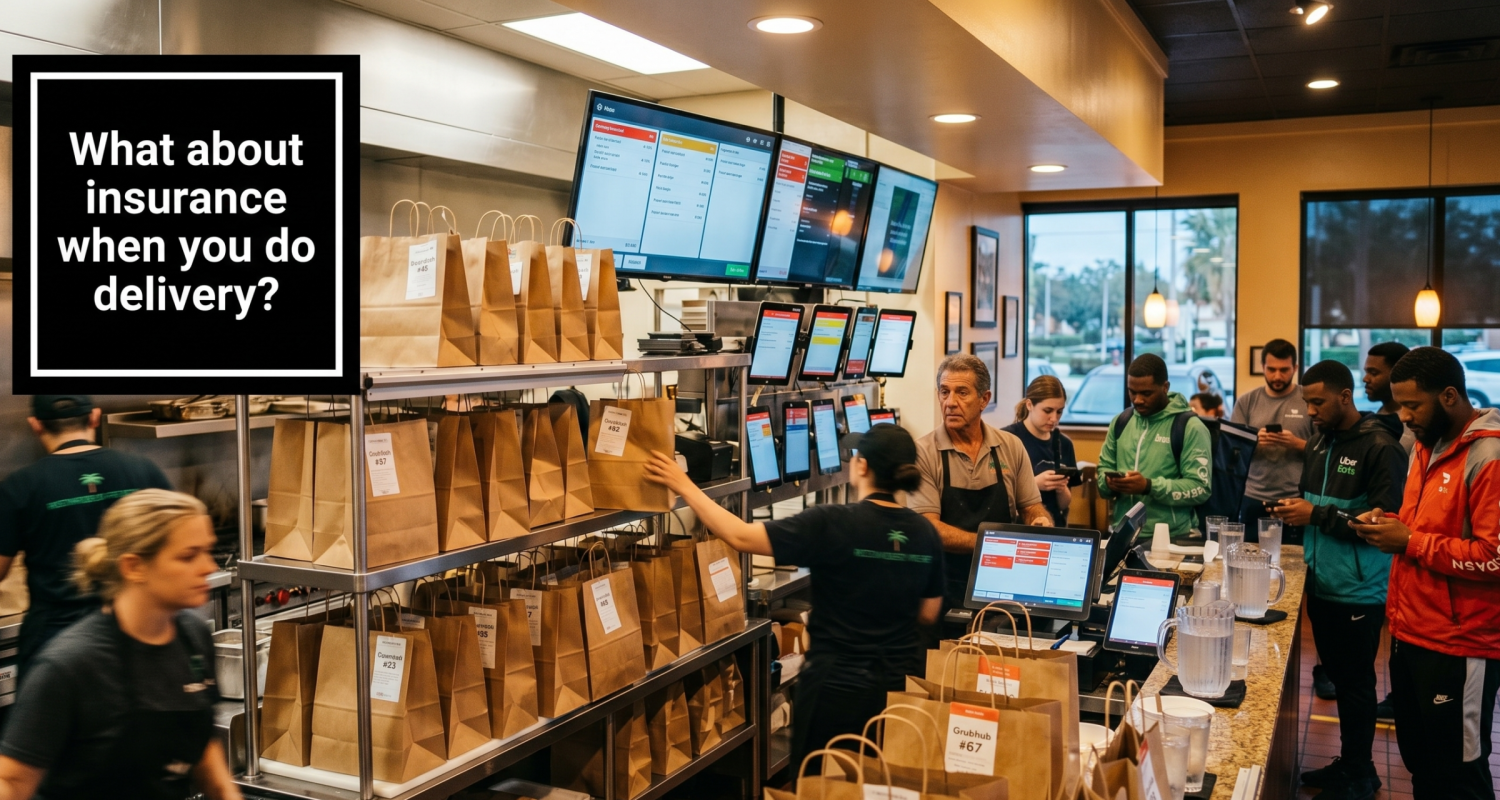
If your restaurant added delivery in the last few years, or if delivery has quietly become a bigger part of how you make money, there is a very real question you should ask: do I need different insurance now that my restaurant does delivery?
In many cases, the answer is yes.
That does not always mean your current policy is useless. It means delivery changes the risk profile of your business, and many restaurant owners underestimate how much that shift matters. A dine-in restaurant and a delivery-focused restaurant are not carrying the same exposure, even if they share the same kitchen, the same staff, and the same menu.
That distinction matters even more now because off-premises dining is no longer a side channel. The National Restaurant Association said in its 2025 off-premises trends coverage that takeout, drive-thru, and delivery had become more important than ever, and it described off-premises business as increasingly important to restaurant operators. Its 2026 industry outlook also emphasizes how operators are investing in technology, ordering systems, and efficiency to adapt to customer behavior and cost pressure.
So if your restaurant now depends on food leaving the building more often than it used to, your insurance should be reviewed through that reality, not through the assumptions of an older business model.
Delivery changes more than transportation
A lot of owners think delivery only creates one new issue: cars.
Cars are a major part of it, but they are not the whole story.
Once your restaurant starts doing delivery, your business may now involve:
- employees driving for work
- personal vehicles being used for business purposes
- third-party drivers or contractors interacting with customers
- off-premises handoff incidents
- hot food and drink injuries outside the restaurant
- accidents while drivers are on the clock
- rushed operations and time-pressure mistakes
- more technology dependence through ordering platforms and apps
- more customer complaints tied to travel time, spills, packaging, and delivery conditions
That is why the question is not only whether your restaurant has delivery. The real question is how your operation now functions because of delivery.
If delivery is now part of your normal business model, then your insurance review should reflect that.
A restaurant with delivery is not being insured like a traditional dine-in operation
This is where many owners get caught off guard.
They may already have a solid-looking policy. They may assume that because they have restaurant coverage, they are covered for whatever happens while the food is being delivered. But that assumption can be dangerous.
CIS already makes this point indirectly on its restaurant and entertainment insurance page by listing multiple overlapping coverages restaurants often need, including property, workers’ compensation, cyber liability, equipment breakdown, and liquor liability depending on the operation. That page reflects an important truth: restaurant risk is layered. Once delivery is added, those layers usually become more complicated, not less. (usa-cis.com)
In other words, delivery is not just a transportation add-on. It can change the entire shape of the business from an insurance standpoint.
The biggest gap many restaurant owners miss
One of the most common blind spots is assuming that a driver’s personal auto insurance automatically protects the restaurant.
That assumption is risky.
Travelers explains that hired and non-owned auto coverage may be needed because commercial auto policies do not automatically cover vehicles you do not own, even when those vehicles are used for business. It also notes that personal auto insurance may provide some protection in some situations, but limitations vary and that is exactly where many businesses get exposed.
That matters a lot for restaurants.
If one of your employees uses their own car to make deliveries, and there is an accident while they are working, the issue is no longer just between that employee and their insurer. Your business may also become part of the problem, especially if the delivery was clearly work-related.
This is one reason CIS published liability insurance options for delivery-focused pizzerias. That article explicitly warns that many restaurant owners assume they are protected because their delivery drivers carry personal auto insurance, when in reality that can leave a major gap in coverage. It also highlights hired and non-owned auto coverage as critical for businesses that rely on employees using their own cars for deliveries. (usa-cis.com)
That is not a niche pizzeria issue. It is a restaurant delivery issue.
Why delivery creates auto liability exposure for the restaurant
Once a driver is delivering on behalf of your restaurant, the accident is not just a personal event. It may become a business liability issue.
If the driver causes injuries, property damage, or a lawsuit while making a work delivery, the restaurant can be pulled into the claim. The Hartford explains that hired and non-owned auto insurance can provide lawsuit liability coverage when employees use personal, rented, or leased vehicles for business errands, though it does not pay for damage to the employee’s own car.
That distinction is important.
A lot of owners think in simple terms: “The driver has insurance, so we’re fine.” But business-related driving creates a different legal and financial context. If the delivery was tied to your business, your restaurant may still face allegations, legal costs, or liability exposure.
That is exactly why commercial auto insurance becomes part of the conversation once delivery enters the model. Travelers states that commercial auto insurance helps protect vehicles owned by and used in the business, while hired and non-owned auto coverage addresses a different but related risk when the vehicles are not owned by the company.
So the answer is not just “Do we have auto insurance?”
The better question is “Who is driving, in what vehicle, and under what business arrangement?”
If employees use their own cars, your restaurant should pay close attention
This may be the most important practical point in the whole article.
If employees use their own vehicles for deliveries, ingredient pickups, or work-related errands, the restaurant may need protection beyond a standard restaurant liability structure. Travelers and The Hartford both explain the importance of hired and non-owned auto coverage when employees use personal vehicles for business.
That matters because a lot of restaurants operate informally in this area.
An owner may think:
- “We only do a few deliveries ourselves.”
- “The driver is part-time.”
- “It’s just his own car.”
- “We only send someone out when it gets busy.”
- “Most orders still happen in-house.”
But insurance problems often come from exactly those casual assumptions. Delivery exposure does not need to be constant to be serious. It only needs one accident, one injury, or one lawsuit to become expensive.
Third-party delivery does not automatically eliminate your exposure
Some owners assume that using a third-party delivery platform means the restaurant is insulated from delivery risk.
Sometimes that assumption is too optimistic.
Even when a third-party platform is involved, your restaurant can still face issues related to packaging, food temperature, order accuracy, timing, customer interactions, hot liquid spills, and claims about how the delivery process was handled. The specific legal and contractual relationships vary, but the broader point remains: outsourcing delivery does not automatically erase all restaurant-side exposure.
That is why your policy review should not stop at “We use an app now.” You still need to understand what part of the delivery risk belongs to the platform, what part belongs to the driver, and what part may still come back to your business.
Delivery also increases operational pressure inside the restaurant
Insurance is not only about what happens on the road.
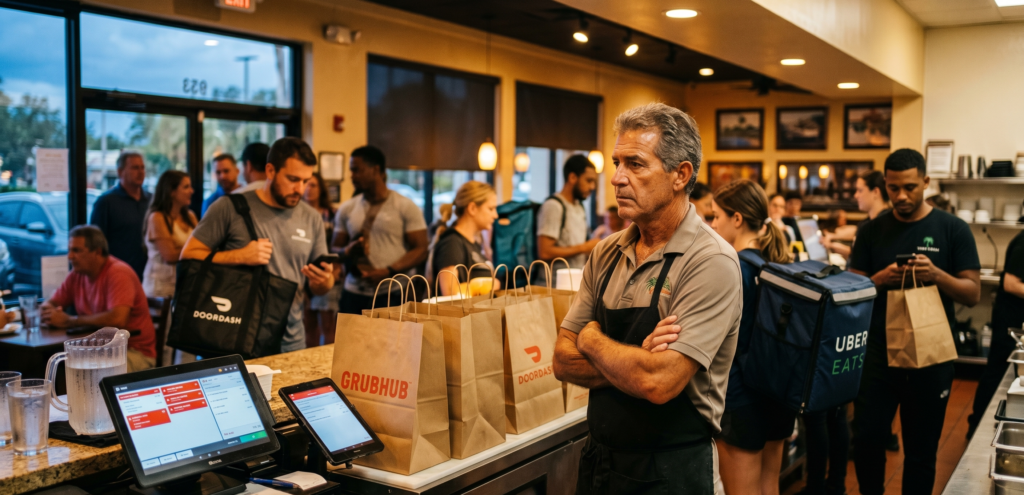
When a restaurant adds delivery, the kitchen often speeds up, staff coordination gets harder, food staging becomes more crowded, and packaging errors become more likely. Drivers may be entering and exiting quickly. Front-of-house flow changes. Pickup areas get tighter. Rushed handoffs become normal.
These things may sound operational rather than insurance-related, but operational pressure often creates claim opportunities.
For example:
- an employee rushing to fulfill orders slips while carrying hot food
- a driver or customer gets hurt in a crowded pickup area
- hot liquids spill during a rushed handoff
- food quality complaints escalate into liability arguments
- confusion around order ownership or pickup process creates confrontations
CIS’s broader restaurant content repeatedly emphasizes how restaurant claims often grow out of ordinary moments that become expensive when speed, public interaction, and weak planning collide. That logic applies to delivery too. (usa-cis.com)
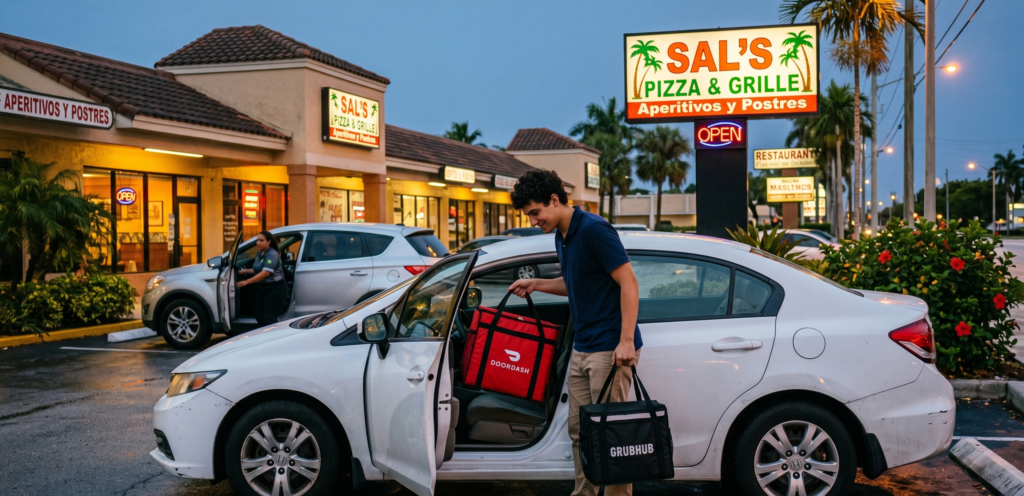
Work-related driving is a real safety issue, not just an insurance line item
Once employees drive for your business, safe driving is no longer only their personal concern. It becomes part of your business risk.
OSHA says employers should ensure workloads and schedules allow employees to drive at a safe speed and follow applicable rules, and it says employers should promote safe driving behavior through safety information and policies. OSHA also notes that preventing work-related roadway crashes requires strategies that combine traffic safety principles and sound safety management practices.
That means if your restaurant does delivery, insurance and safety are connected.
A restaurant that treats delivery casually may end up with weak documentation, weak driver expectations, and weak control over how employees behave on the road. And weak control can become expensive very quickly after an accident.
Delivery can affect more than auto coverage
This is another place where owners simplify too much.
Yes, delivery often triggers questions about commercial auto insurance and hired and non-owned auto coverage. But it can also affect broader insurance decisions because your operations have changed.
Your restaurant may now need to review:
- whether your general liability structure still fits the business
- whether employee duties have materially changed
- whether workers’ compensation assumptions still match job reality
- whether order volume and revenue mix have shifted
- whether cyber risk has increased because ordering systems matter more
- whether your restaurant is more vulnerable to service disruption than before
The National Restaurant Association’s 2026 outlook says operators are increasingly investing in ordering, AI, and data analytics. That matters because the more your business depends on digital systems to process off-premises orders, the more fragile operations can become if those systems fail or are disrupted.
So even if delivery starts as “just another revenue stream,” it often ends up changing labor, technology, customer interaction, and transportation all at once.
Delivery and food handling can create a different kind of customer complaint
Delivery also changes the way the customer experiences the food.
In a dine-in setting, the restaurant controls timing, presentation, and immediate corrections. In delivery, time and travel enter the equation. Temperature, packaging, spills, delays, and drop-off problems become part of the customer experience in a way they were not before.
CDC guidance for restaurants and bars has recognized delivery and curbside options as important operational formats, which reinforces the idea that off-premises service is now a meaningful part of restaurant operations, not an exception.
That does not mean every delay becomes an insurance issue. But it does mean delivery broadens the chain of events between kitchen and customer. And when that chain gets longer, more things can go wrong.
If your restaurant owns delivery vehicles, the conversation changes again
If the restaurant owns the cars, scooters, vans, or other vehicles used for deliveries, the issue becomes more direct.
Travelers says commercial auto insurance protects vehicles owned by and used in the business. That means if the restaurant itself owns the delivery vehicles, the business should not be relying on assumptions designed for non-owned cars.
This is one of the clearest situations where the answer to the article’s main question is yes.
If your restaurant owns delivery vehicles, you are not just a restaurant with delivery. You are a restaurant operating business vehicles. That is a different exposure and should be treated like one.
Delivery-heavy restaurants often need a more tailored review
This is exactly why generic “small business insurance” thinking can break down.
A restaurant that makes a few deliveries each week is different from a pizzeria where off-premises sales are a major revenue stream. A ghost kitchen is different from a casual dine-in concept that recently turned on app delivery. A catering-heavy restaurant with staff driving food to events is different from a sandwich shop using a third-party platform.
That is why key questions for reviewing your restaurant insurance plan becomes such a relevant internal resource for this topic. Once delivery changes your model, it becomes important to ask whether your current coverage still matches the business you are actually running. (usa-cis.com)
A delivery-heavy model usually deserves a delivery-aware review.
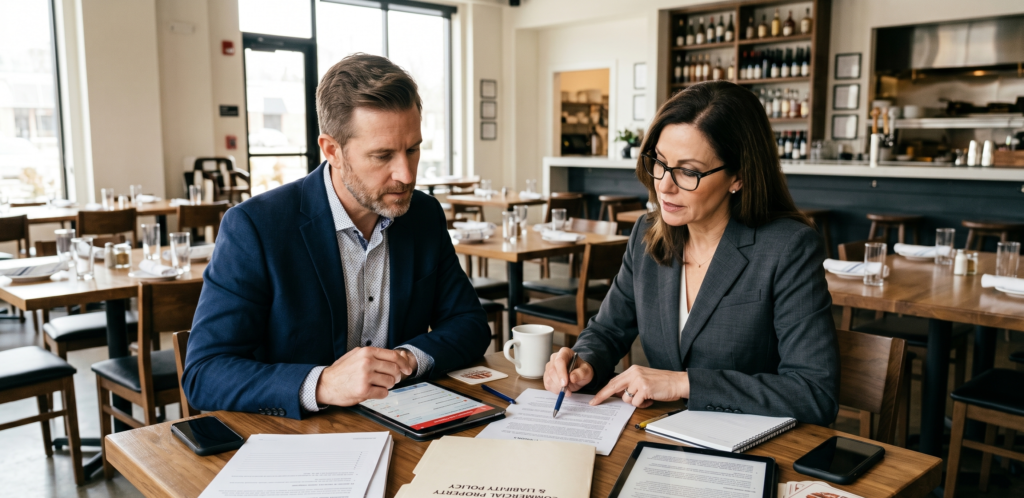
Warning signs that your insurance may no longer fit your restaurant
If you are wondering whether your current insurance is still aligned, these are good warning signs to take seriously:
- delivery has become a regular source of revenue
- employees use personal vehicles for deliveries or pickups
- you are not sure whether your policy contemplates delivery exposure
- you rely on app-based ordering much more than before
- your kitchen workflow has changed significantly because of off-premises orders
- you are using drivers, contractors, or staff in a more flexible way than before
- you have never specifically discussed delivery with your agent
- you assume a driver’s personal policy covers everything
If several of those are true, then the answer is probably not “panic.”
It is “review the structure before something goes wrong.”
This is also a bankruptcy issue, not just an insurance issue
One reason this topic matters so much is that delivery risk can become a financial stability issue.
CIS recently argued in what should a restaurant do to avoid bankruptcy that restaurants often fail because smaller operational, legal, and insurance problems accumulate over time. Delivery mistakes, underinsurance, liability exposure, and lack of planning are part of that broader pattern. (usa-cis.com)
That is why this article is not only about compliance or policy language.
It is about whether your restaurant has quietly evolved into a riskier business while your insurance stayed stuck in the past.
So, do you need different insurance now that your restaurant does delivery?
In many cases, yes.
You may need a different structure, not just a slightly edited version of what you already had. Delivery can create exposures tied to work-related driving, employee vehicle use, customer injury claims outside the premises, rushed operations, and technology dependence. If your restaurant owns delivery vehicles, commercial auto insurance becomes especially important. If employees use their own cars, hired and non-owned auto coverage may be one of the most important protections you are missing.
And even beyond auto issues, delivery can signal that your entire operation needs a more tailored insurance review.
The safest assumption is not that delivery “probably counts” under your old setup.
The safer move is to ask whether the business you run now is the same business your policy was built for.
If the answer is no, then your insurance should probably change too.