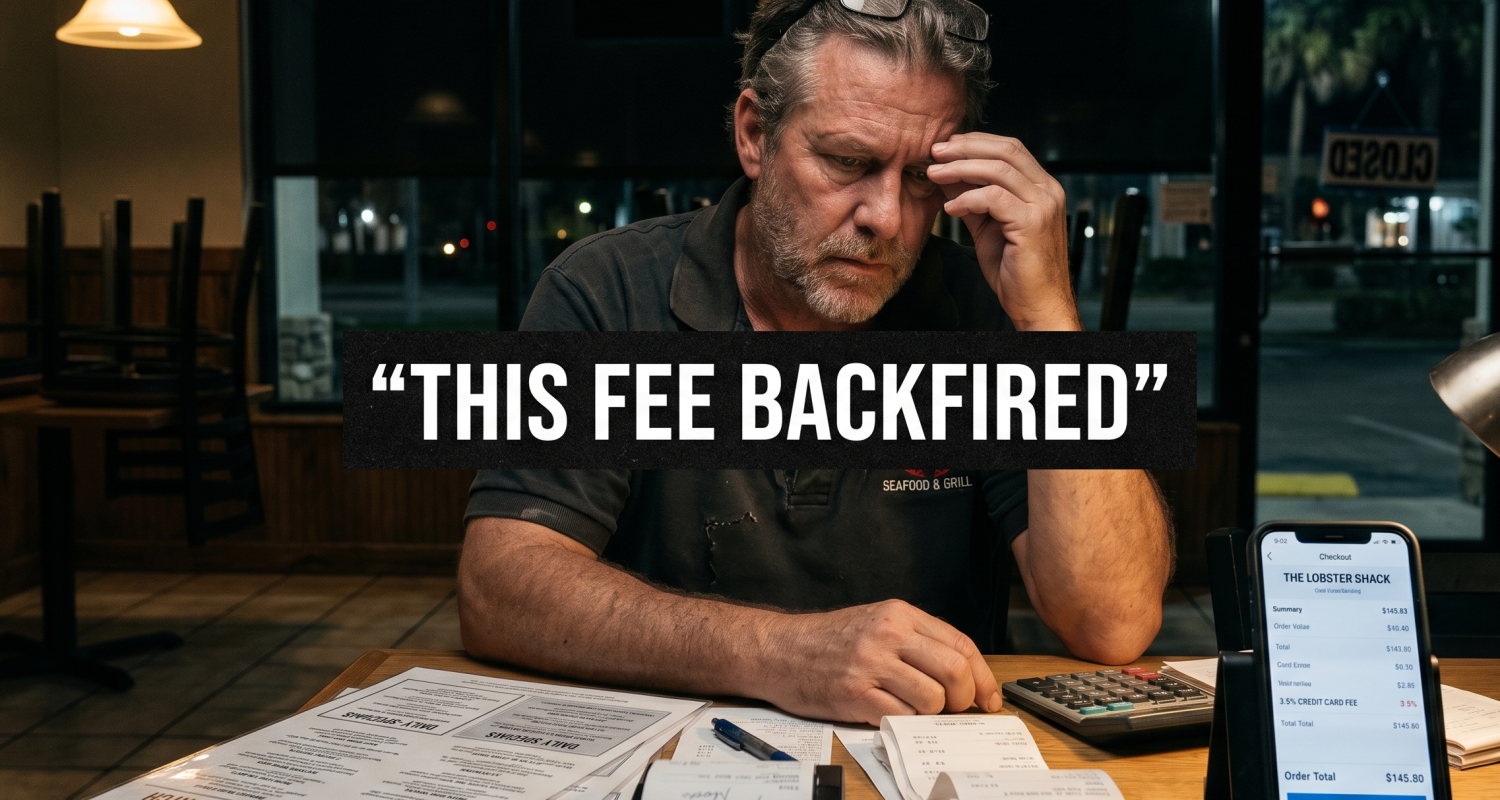
The fee that cost us customers did not look dangerous when we first added it.
At the time, it looked practical. Costs were still high. Margins felt squeezed. Every operator I knew was trying to protect profit without pushing menu prices into absurd territory. So when we added a mandatory charge, it felt like a business decision, not a risk decision.
That was the mistake.
In Florida, this is now more than a pricing issue. It is also a disclosure issue, a customer-trust issue, and a compliance issue. Florida Statute 509.214 says that, effective July 1, 2026, if a public food service establishment charges an operations charge, it must provide notice on the menu, contract, website, or mobile app where orders are placed, when applicable, and it must also show the charge properly on the bill and receipt. The statute defines an operations charge broadly enough to include service charges, automatic gratuities, credit card surcharges, delivery fees, and other mandatory add-ons.
That is why this story matters. A fee can start as a margin decision and end as a customer-loss decision if the restaurant handles it badly. Baker McKenzie’s April 2026 analysis makes the same basic point: Florida expanded the disclosure requirements for mandatory customer fees in restaurants and hospitality businesses, and those changes take effect on July 1, 2026.
At first, the fee felt like a smart move
If I tell this like a real owner would tell it, the beginning is simple.
We were under pressure. Food costs were not relaxing. Labor was not getting easier. Insurance, energy, and swipe fees all kept eating at the business. The National Restaurant Association says those cost categories remain major pain points for operators in 2026.
So when we added a fee, the thinking was obvious:
we are not trying to trick anybody, we are trying to survive.
That is why so many owners get this wrong. They think the moral question is whether the charge itself is justified. Sometimes it is. But the more dangerous question is whether the fee is being disclosed clearly enough that the business does not end up creating distrust, complaints, chargebacks, or regulatory exposure.
JD Supra’s summaries of the law make that clear too. They explain that Florida’s revised operations charge framework requires conspicuous disclosure across customer touchpoints, including menus, websites, mobile apps, bills, and receipts.
The problem was not only the fee. It was confusion.
This is where the story shifts.
The fee itself did not immediately feel like the issue. The issue was what happened around it.
Customers started asking:
What is this charge?
Is this the tip?
Why is this on the bill?
Why did nobody mention this earlier?
Why does the receipt look different from the menu?
That is the part many owners underestimate. A badly handled charge can turn a normal payment moment into a trust problem. And in a restaurant, trust does not break in abstract legal language. It breaks in real interactions: at the table, at the host stand, at checkout, in reviews, in online complaints, and in staff explanations that do not match each other.
Florida’s statute is structured around exactly that reality. It requires the business to show the amount or percentage and the purpose of the operations charge in the places where the customer actually encounters the transaction.
That should tell owners something important:
the state is not only interested in whether a fee exists. It is interested in whether the customer sees it clearly enough before and during payment.
A vague fee can make a restaurant look slippery fast
This is the deeper business problem.
When a customer sees a mandatory charge late, or does not understand whether it is a gratuity, a surcharge, or something else, the restaurant starts to look slippery even if management did not intend to mislead anyone.
That matters because customer frustration is not a side issue. It affects:
- repeat business
- online reviews
- staff stress
- manager time
- charge disputes
- brand trust
- conversion on digital orders
The fee starts as a revenue-protection tool and ends up weakening the business in the places that matter most.
That is why restaurant and entertainment insurance is a natural internal link for this article. The broader CIS point is that restaurant risk is layered. Sometimes the thing that hurts the business is not a classic accident. Sometimes it is a process that creates friction, weakens trust, and exposes the owner to unnecessary conflict. (usa-cis.com)
Florida made this a real compliance issue, not just a customer-service issue
This is where the story becomes sharper.
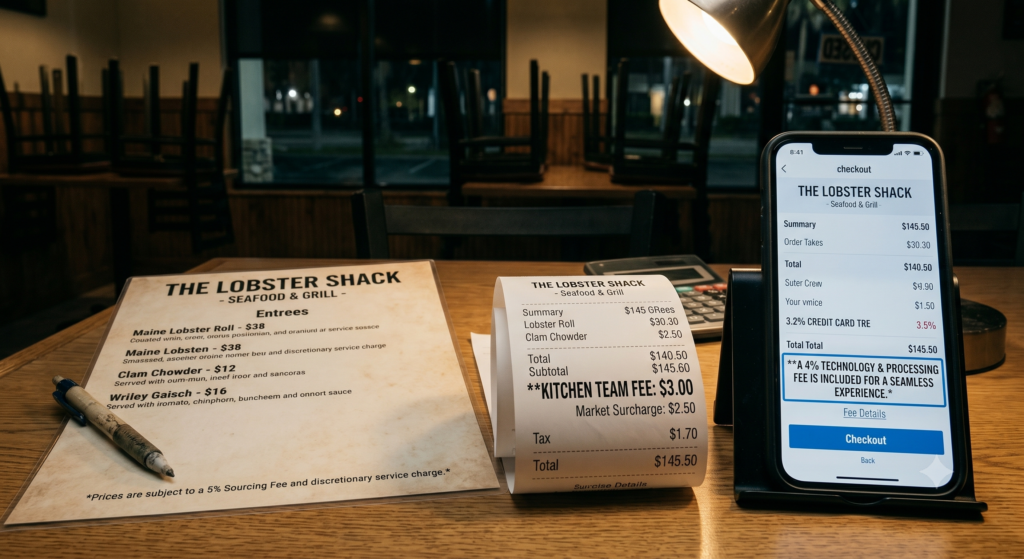
Before, some owners could treat fee disclosure like a soft best practice. Now Florida has made the issue more explicit. Florida Statute 509.214 does not simply mention disclosure vaguely. It specifies that the charge must be noticed on the menu, contract, website, or mobile app where orders are placed, when applicable. It also requires the bill to show that an operations charge is included and requires the receipt to contain separate lines for gratuity, an operations charge, and sales tax.
That matters because many restaurants now operate across several order environments at once:
- dine-in menus
- QR menus
- website checkout
- mobile ordering
- catering contracts
- event proposals
- point-of-sale receipts
The more channels you use, the easier it becomes for your disclosure to become inconsistent.
And inconsistency is exactly where trouble begins.
The staff explanation can make everything worse
One of the easiest ways for this to blow up is not legal language. It is human inconsistency.
If the owner understands the fee but the team does not, everything gets worse.
One employee says it is basically a tip.
Another says it is a house charge.
Another says it is mandatory.
Another says the guest can ask about it later.
That kind of inconsistency makes the restaurant look disorganized at best and deceptive at worst.
This is where the issue becomes operational. It is not just about what the menu says. It is about whether the business can explain itself coherently. That is why key questions for reviewing your restaurant insurance plan is also a natural internal link here. The real CIS lesson behind many of these articles is that when the business changes how it operates, management has to review the structure honestly before the business pays for the confusion later. (usa-cis.com)
Digital ordering can multiply the risk
This part matters a lot more now than it would have a few years ago.
If your restaurant uses online ordering, a bad fee process can become a scaled problem. A weak disclosure on a website or mobile app is not just one awkward table-side conversation. It can become hundreds of bad customer experiences with no human correction until the complaint arrives later.
Florida Statute 509.214 clearly extends the disclosure requirements to the website or mobile app where food and beverage orders are placed, when applicable.
That means a restaurant cannot treat digital ordering as a side system. If the fee is disclosed differently on the menu than on the app, or if the purpose of the charge is unclear online, the business may be setting itself up for avoidable friction and legal vulnerability.

This is also a profitability trap
The most ironic part of the whole story is that the fee was supposed to protect profit.
That is what makes this such a strong article topic.
A mandatory charge may be added because the owner is trying to preserve margin in a very hard environment. The National Restaurant Association says restaurant operators in 2026 are still under strong cost pressure from food, labor, insurance, energy, and transaction fees.
So the instinct makes sense.
But if the fee creates enough confusion, distrust, or negative customer reaction, it can do the opposite of what it was supposed to do. It can start costing the restaurant customers. That is why what should a restaurant do to avoid bankruptcy is such a useful internal connection here. The lesson in that CIS article is that restaurants often get into deep trouble because smaller financial and operational problems stack over time. A badly handled fee can absolutely become one of those stacking problems. (usa-cis.com)
The real lesson is not “never charge a fee”
That would be too simple.
The real lesson is this:
if you charge a mandatory fee, you need to handle it with the same seriousness you would bring to any other customer-facing risk.
That means:
- clear wording
- consistent wording
- consistent staff explanation
- consistent menu and receipt treatment
- digital consistency
- honest review of how customers will actually experience the charge
If the restaurant is not prepared to do those things well, then the fee may become more expensive than the margin it was supposed to protect.
The sharper conclusion
So what is the real point of the story?
It is not that every fee is abusive.
It is not that restaurants should never use mandatory charges.
It is this:
The fee that looked like it would protect the business started costing us customers because we treated it like a pricing trick instead of a trust and compliance issue.
Florida’s operations charge rules are explicit enough now that owners should stop improvising in this area. The smarter move is to treat the charge like part of the customer experience and part of the risk structure at the same time.
Because once a fee creates confusion, it stops being just a fee.
It becomes a business problem.