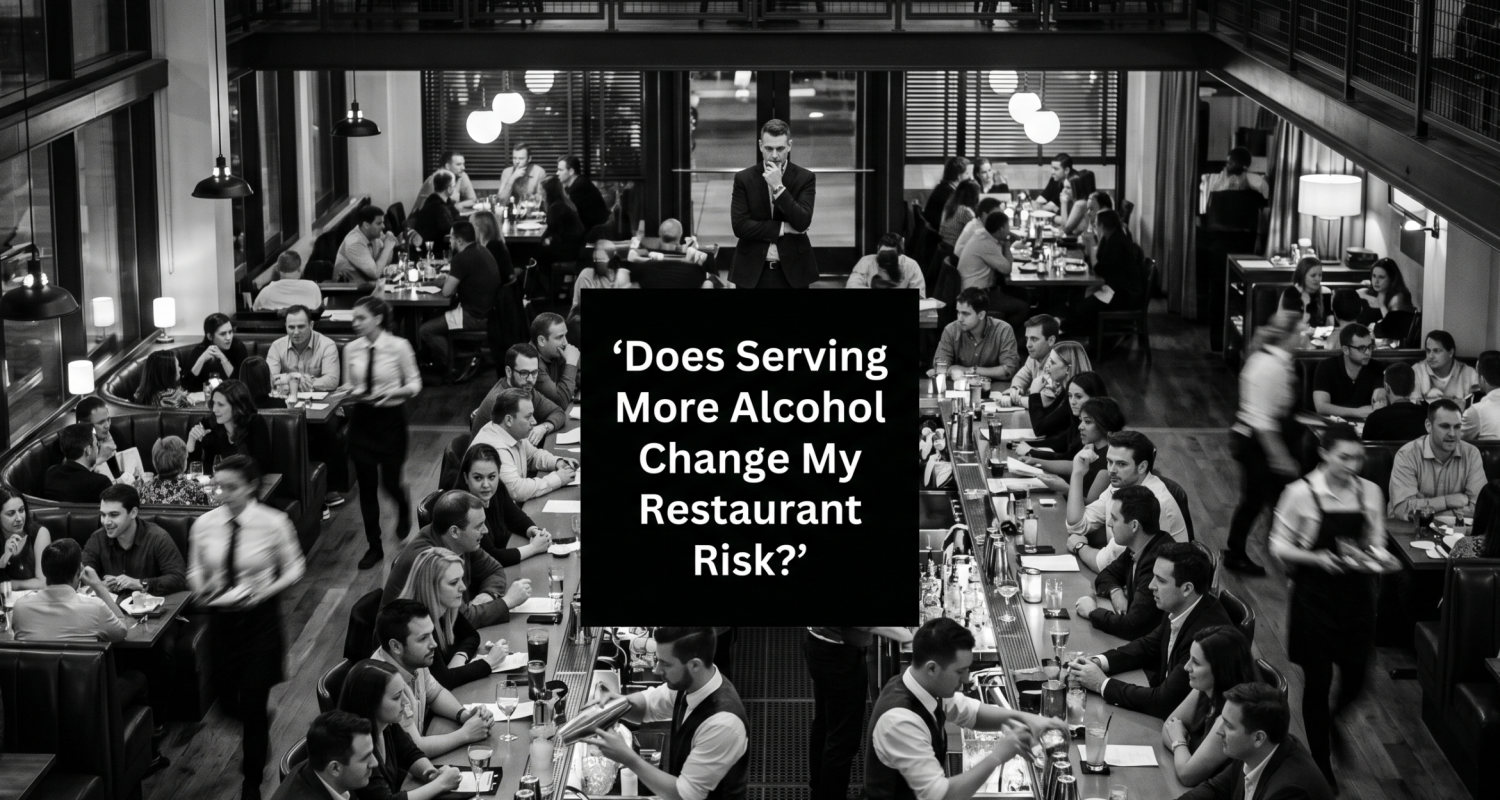
If your restaurant serves more alcohol than it used to, the right question is not only whether beverage sales are helping your margins. The better question is this: does serving more alcohol change my restaurant risk?
In many cases, yes.
That does not automatically mean your restaurant is suddenly exposed to catastrophic liability just because drink sales increased. It means the business may have shifted in a way that changes guest behavior, staff pressure, supervision demands, and the kind of insurance review you should be doing now. CIS already treats this as a real exposure area: its restaurant and entertainment insurance page lists liquor liability insurance alongside general liability, property, workers’ compensation, cyber liability, and equipment breakdown as part of the restaurant coverage mix.
That makes sense because alcohol is not just another menu item. It changes how people behave, how long they stay, how your team has to manage service, and what kinds of claims can become possible. And from a business standpoint, this matters even more in an industry still working through margin pressure. The State of the Restaurant Industry 2026 says the restaurant industry is cautiously optimistic about 2026 and projects industry sales of $1.55 trillion, but that optimism sits inside an environment still shaped by cost pressure and operational strain.
So this is not really a beverage-program question by itself. It is a risk-management question.
The business may look the same, but the exposure may not be
One reason owners miss this issue is that the restaurant may still look like the same concept from the outside.
Maybe you still have the same dining room, same kitchen, same staff count, and same basic customer base. But if alcohol now makes up a larger share of revenue, or if the restaurant is leaning harder into cocktails, happy hour, evening traffic, or bar-driven sales, the operating reality may have changed more than it seems.
That shift can show up in ways like these:
- guests staying longer
- more evening congestion
- more social or celebratory traffic
- more judgment calls by servers and bartenders
- more pressure on managers to handle difficult guest situations
- more late-night exits to the parking lot
- more chances for confrontation, falls, or impaired behavior
- more dependence on drink service as part of the business model
This is why key questions for reviewing your restaurant insurance plan is such a relevant internal reference point. CIS explicitly says, “If your restaurant, bar, or café serves alcohol, liquor liability insurance is absolutely non-negotiable,” and frames alcohol service as a review issue that owners should address deliberately.
The important point is not that every alcohol-serving restaurant becomes equally risky. The important point is that once alcohol becomes more central, the risk profile often stops matching the assumptions of a simpler dining model.
More alcohol usually means more staff judgment is required
A lot of insurance discussions stay too abstract. They focus on policies, endorsements, and legal terms. But one of the biggest practical changes created by alcohol service is not paperwork. It is judgment.
When alcohol becomes a bigger part of the business, your staff has to make more real-time decisions:
- when to check identification
- when to slow or stop service
- when a guest is becoming a problem
- when a bartender needs manager backup
- when a situation looks socially uncomfortable but legally important
- when a patron should not be served again
- when guest behavior is beginning to spill into safety exposure
That matters because alcohol-related risk is usually not created by one dramatic movie-style moment. Often it comes from smaller failures of attention and consistency. The team is busy, the shift is loud, the room is full, and someone makes a judgment call too late.
That is one reason liquor liability insurance for restaurants with full bars is such a useful CIS article here. CIS describes liquor liability insurance for restaurants Florida as protection against claims tied to the actions of intoxicated patrons and emphasizes that alcohol-related incidents can expose a business to serious legal and financial consequences.
So yes, when alcohol sales grow, staff judgment matters more. And when staff judgment matters more, risk management matters more too.
Florida law does not create unlimited liability, but it does not erase alcohol risk either
This is where owners can become either too relaxed or too alarmed.
Florida does not impose unlimited liability every time a guest leaves after drinking. The controlling statute is 768.125 Liability for injury or damage resulting from intoxication. It says that a person who sells or furnishes alcohol to a person of lawful drinking age is generally not liable for injury or damage caused by that person’s intoxication, except when someone willfully and unlawfully serves a minor or knowingly serves a person habitually addicted to alcohol.
That is an important legal limit. But it is not a reason for complacency.
There are at least three reasons for that.
First, owners and managers do not always understand where legal exposure begins and ends in the moment.
Second, being named in a dispute, claim, or lawsuit is still costly and disruptive even before ultimate liability is resolved.
Third, alcohol-related risk is broader than one statute. It includes on-premises fights, falls, property damage, security incidents, and guest-management failures that can still create major business pain.
So the mature view is neither “Florida law protects us from everything” nor “one drink sale could destroy the business.” The real view is that alcohol changes the claim environment and raises the stakes of judgment, supervision, and coverage review.
If alcohol becomes more important to revenue, insurance should become more intentional
This is probably the cleanest business takeaway in the whole topic.
If alcohol is now carrying more of your profit, then your insurance review should become more intentional too.
The National Restaurant Association’s beverage-alcohol materials describe alcohol as a high-margin opportunity for operators, and one of its prior analyses found that among full-service restaurants selling alcohol-based beverages, drinks represent about 21% of total sales. That is not a universal number for every concept, but it shows why alcohol matters so much commercially.
And this is where restaurant owners can get trapped by their own success.
The more alcohol helps the numbers, the easier it is to think of it only as a profit lever:
more cocktails, better margins, stronger checks, longer guest stays, more attractive evening traffic.
But that commercial upside can quietly create a more bar-adjacent operating environment inside a business that still thinks of itself as “just a restaurant.” CIS makes that point clearly in bar and pub insurance: managing liquor liability, where it says liquor liability insurance is a critical component of risk management but only one piece of a larger layered protection strategy.
That is the right frame. If alcohol becomes more central, the answer is not only “buy one extra coverage and forget it.” The answer is to review whether the whole operating model has shifted.
The crowd may change before the owner fully notices it
Sometimes the biggest change is not the drinks themselves. It is the kind of room they create.
A restaurant that serves more alcohol than it used to may start attracting:
- larger evening groups
- more celebratory dining
- more guests who linger
- more guests who arrive specifically for drinks
- more nightlife-adjacent traffic
- a higher concentration of guest behavior that needs monitoring
This does not mean the concept has become a bar. But it may mean the behavior pattern on the premises is moving closer to one.
That matters because a crowd that stays later and drinks more tends to create different operational concerns:
parking lot issues, noise complaints, arguments, broken glass, falls, guest removal decisions, manager intervention, and pressure on staff to keep service moving while also making judgment calls.
CIS highlights that logic across multiple alcohol-related articles. In comparing insurance options for sushi vs. tapas restaurants, it says Liquor Liability Insurance is designed to protect an establishment from claims arising from alcohol-related incidents, whether they occur on the premises or after a patron leaves.
That is why the question “does serving more alcohol change my restaurant risk?” is not theoretical. It goes to the heart of how the space functions in real life.
General liability and property issues do not disappear when alcohol risk rises
Another mistake owners sometimes make is reducing the topic to only liquor liability insurance.
That coverage matters. But it is not the only thing that matters.
If more alcohol changes how the premises are used, then other coverage considerations may deserve attention too:
- more crowded bar zones
- more wear on the premises
- more late-night supervision needs
- more third-party injury exposure
- more need for manager intervention
- more security expectations in some concepts
CIS’s restaurant and entertainment insurance page is helpful here because it places liquor liability insurance inside a wider restaurant-risk structure rather than treating it as a standalone curiosity. The page also includes general liability and property coverage as core pieces of the broader restaurant insurance framework.
That is the right way to think about it. If the business changes because of alcohol, the whole protection structure may need a closer look, not just one line item.
Review becomes more important when the shift happened gradually
Many restaurant owners do not make one dramatic decision like, “Starting tomorrow, we are an alcohol-driven concept.”
What usually happens is slower:
- the cocktail program improves
- margins on beverages start to matter more
- guests respond well
- happy hour gets stronger
- late-evening traffic builds
- more bar seating gets used
- management starts leaning on alcohol sales to support profitability
Then six or twelve months later, the operating reality is materially different, but the owner may still be thinking with the older risk model in mind.
That is exactly why what if my restaurant serves more alcohol than it used to? already exists on the CIS site. That internal article, published recently, focuses on whether the insurance structure should be reviewed when alcohol sales grow and the restaurant becomes a different kind of business operationally.
So for SEO and editorial continuity, this article works best when it sharpens that theme from a slightly different angle: not just “do I need different insurance?” but “has the risk profile itself changed?”
Beverage strategy and risk strategy should be connected
Restaurant owners often divide these issues mentally.
One part of the brain handles revenue:
How do we improve margins? How do we sell more drinks? How do we make the evening daypart stronger?
Another part handles insurance:
Do we have coverage? When does the renewal hit? What did the broker say?
But when alcohol becomes more important, those two conversations should not stay separate.
A beverage strategy that is built to maximize sales without reviewing the risk implications is incomplete. And an insurance review that ignores how the beverage program has evolved is also incomplete.
The National Restaurant Association continues to treat beverage alcohol as a meaningful sales and innovation area for operators, while CIS consistently treats alcohol service as a material liability issue. The gap between those two realities is exactly where smart owners need to think more carefully.
What owners should be reviewing right now
If your restaurant serves more alcohol than it did a year ago, these are the questions worth asking now:
- Has alcohol become a more important share of revenue?
- Are guests staying later than they used to?
- Are managers stepping into more alcohol-related guest situations?
- Has the room become more crowded or more social at night?
- Are bartenders and servers making more difficult judgment calls?
- Does the current policy actually reflect the business as it operates now?
- Have we reviewed liquor liability insurance specifically, or are we just assuming it is covered somewhere?
- Has the concept become more nightlife-adjacent without us really naming it?
That is where key questions for reviewing your restaurant insurance plan becomes one of the best internal links for this topic. It is already structured around the idea that owners should ask the uncomfortable questions before a claim forces them to.
This is a survival issue, not only a compliance issue
One reason this topic matters is that alcohol-related problems can destabilize a business fast.
Not every problem becomes a lawsuit. Not every lawsuit becomes a disaster. But the combination of legal cost, management distraction, staff stress, reputational damage, and financial pressure can become serious very quickly, especially in an industry still managing narrow margins and unstable operating conditions. The State of the Restaurant Industry 2026 projects sales growth, but it does so in a sector still dealing with complex cost and operating pressures.
That is why this should be treated as a business-survival question, not only a technical insurance question.
It belongs next to other CIS themes such as why is my restaurant insurance getting so expensive? and what should a restaurant do to avoid bankruptcy because the real danger is often not one isolated event. It is a chain of strain:
higher pressure, more alcohol, more guest-management complexity, weaker review discipline, then one incident lands at the wrong time.
So, does serving more alcohol change your restaurant risk?
Yes, in many cases it does.
It can change staff judgment demands, guest behavior, crowd patterns, supervision needs, and the types of claims or disputes that become plausible. Florida’s 768.125 Liability for injury or damage resulting from intoxication sets important legal boundaries, but it does not make alcohol-related risk disappear. CIS’s own content consistently treats liquor liability insurance as a core protection whenever alcohol is part of the business, and the broader restaurant and entertainment insurance framework reflects that alcohol belongs inside the larger restaurant-risk conversation.
The smartest move is not to ask only whether drinks are improving your margins.
The smarter move is to ask whether your restaurant has quietly become a different kind of operation because of alcohol, and whether your insurance review has kept up with that reality.
Because when alcohol becomes more central to the business, risk usually does too.