The system that made us fragile did not look dangerous when we installed it.
At first, it looked like progress.
The new tools promised cleaner operations, better reporting, smarter ordering, tighter labor decisions, faster marketing, and a more modern customer experience. In a difficult market, that kind of system does not feel risky. It feels responsible.
That is exactly why this story matters.
Many restaurants are adding more digital tools because pressure is pushing them there. Restaurant operators are dealing with rising costs, labor strain, tighter margins, and more complicated guest expectations, so technology starts to look like a rational way to regain control. The National Restaurant Association has been openly encouraging that shift through resources like choosing the right AI tools for your restaurant and a restaurateur’s intro to AI, both of which frame AI as a practical tool for restaurant efficiency, customer service, and decision-making.
The problem is not that the technology is useless.
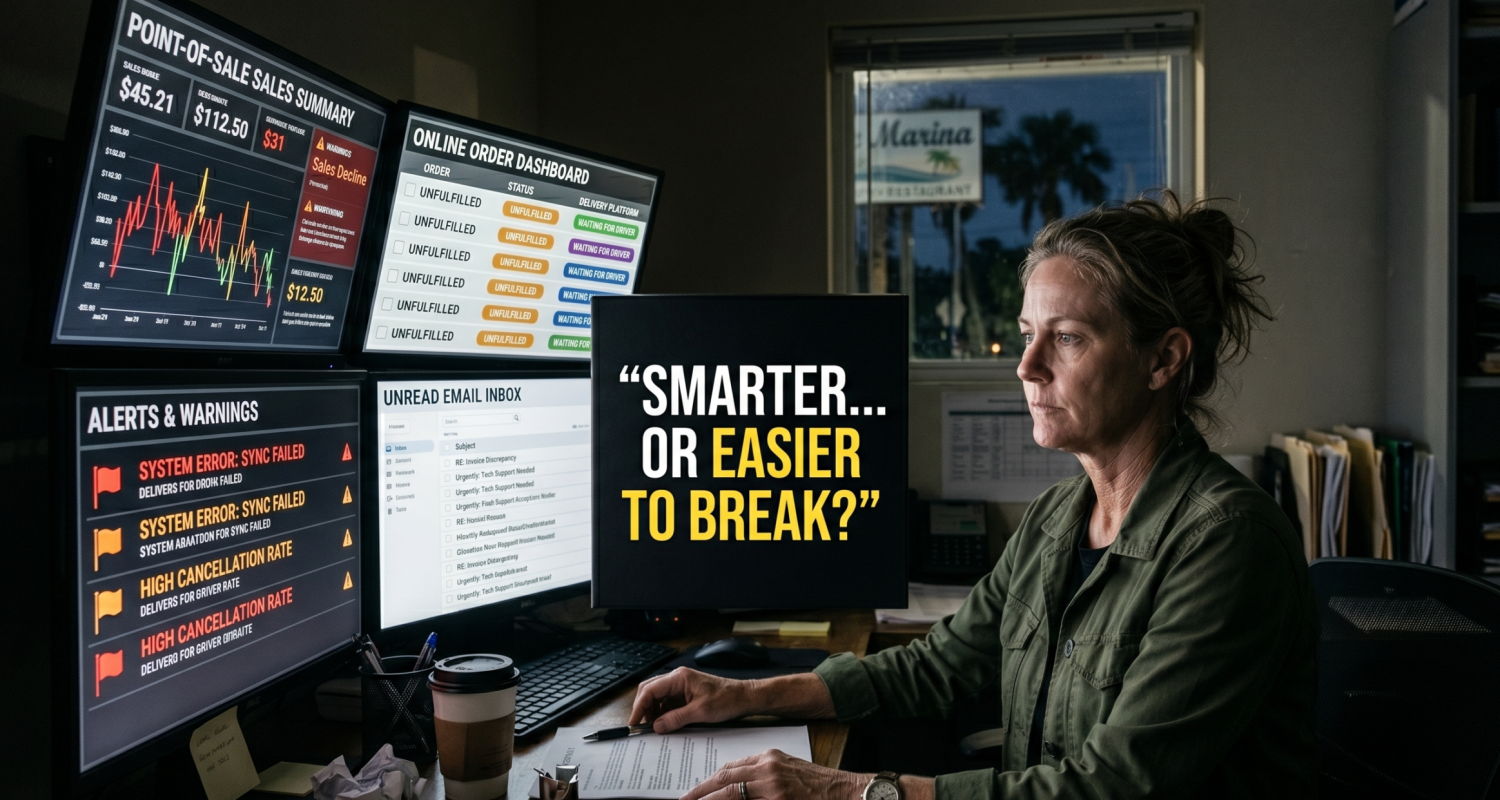
The problem is that systems that make a restaurant feel smarter can also make it easier to break.
At first, the system felt like control
If I tell this like a real owner would tell it, the beginning is simple.
We were trying to fix real problems. We wanted more visibility into sales, labor, and guest behavior. We wanted fewer blind spots. We wanted better tools for marketing, staffing, and service. The new system seemed to promise exactly that. It felt like the kind of investment serious operators make when they are trying to tighten the business.
That is not irrational. Restaurant technology adoption is not a fad anymore. Restaurant Dive, reporting on the National Restaurant Association’s 2026 industry report, said 26 percent of restaurant operators are already using AI-related tools in their restaurants, with marketing and administrative tasks among the leading use cases.
So the story is not “we made a stupid decision.”
The story is “we made a modern decision, but we did not fully understand the new dependency we were creating.”
The system started mattering more than we realized
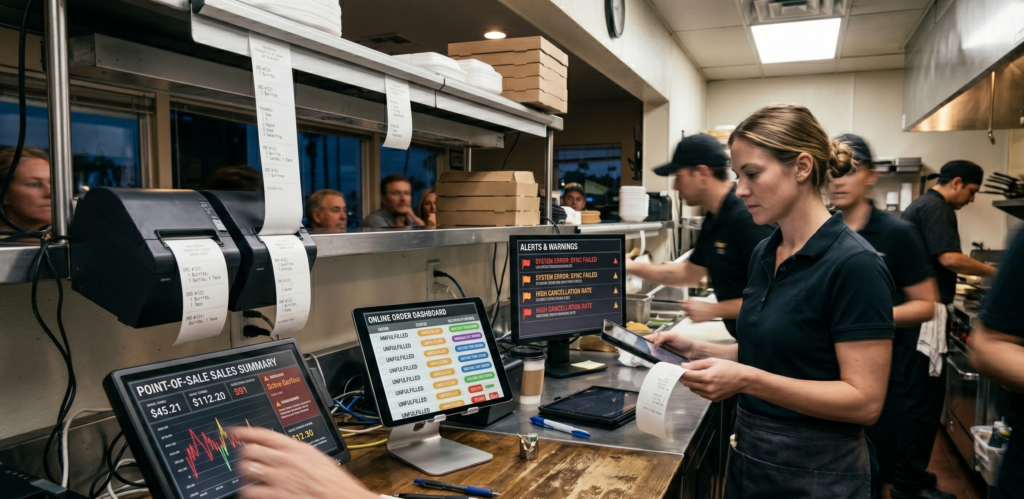
One of the biggest shifts in restaurants is not only that they use more technology. It is that they rely on it more deeply than they admit.
A restaurant today may depend on digital systems for:
- online ordering
- point-of-sale transactions
- reservations
- loyalty programs
- customer messaging
- staff scheduling
- email-based vendor coordination
- inventory insights
- marketing automation
- delivery integrations
That changes the nature of the business.
When a system is lightly helpful, failure is annoying.
When a system becomes operational infrastructure, failure becomes dangerous.
That is why the federal continuity lens matters here. Ready.gov’s Business Impact Analysis says businesses should identify how disruptions affect operations and gather the information needed to build recovery strategies. That is exactly the right frame for restaurant technology risk. Once digital systems become central, an outage is no longer just an IT inconvenience. It is an operating disruption.
The restaurant felt smarter, but it was becoming more brittle
This is the contradiction at the center of the article.
The more connected the operation became, the more advanced it felt. Dashboards improved. Orders flowed faster. Marketing got more targeted. Data looked sharper. The restaurant started to feel like it had more visibility and more precision.
But sophistication can hide fragility.
Nation’s Restaurant News put that very directly in its 2026 risk roundup. It identified cyber incidents and AI-enabled fraud as one of the top risks restaurants cannot afford to overlook, warning that restaurants are increasingly exposed through POS systems, employee email accounts, and connected tools that can trigger outages, liability, and lost revenue. It also noted that AI-generated restaurant content can create issues like misrepresentation or even allergen-related liability if used carelessly.
That is the lesson:
the system can improve the operation and quietly make it more failure-sensitive at the same time.
The danger is not only hacking. It is dependence.
A lot of owners hear “cyber risk” and think first about dramatic breaches or stolen credit card data.
Those things matter. But the more immediate business threat is often dependence.
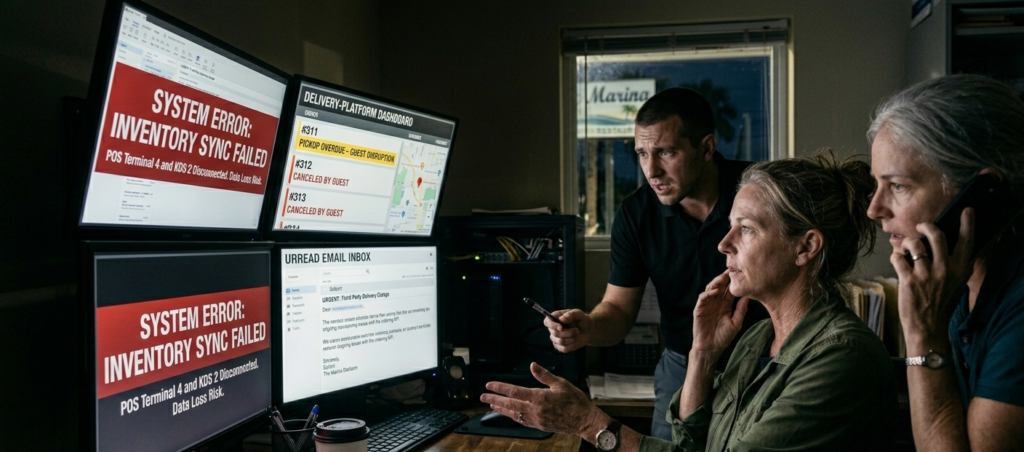
If the restaurant cannot process orders correctly, cannot access guest information, cannot trust its dashboards, cannot communicate internally, or cannot operate key systems during service, the damage may appear first as interruption rather than theft.
That is why restaurant and entertainment insurance is such a natural internal link for this topic. CIS’s restaurant coverage page includes Cyber Liability Insurance and describes it as protection for losses related to cyber attacks, data breaches, and other technology-related incidents. That reflects a very current truth: in modern restaurants, tech risk is no longer outside the business. It is inside the business model itself.
Once the system becomes central, failure no longer feels technical.
It feels operational.
And then financial.
AI-enabled fraud is a real restaurant risk now
This is where the article needs to be current, not generic.
The phrase cyber incidents and AI-enabled fraud sounds futuristic until you realize how vulnerable restaurant teams actually are. These are not organizations built like cybersecurity companies. They are built to move fast, serve guests, respond under pressure, and keep the shift alive. That makes them vulnerable to convincing fake messages, impersonation, manipulated content, or digital instructions that look credible enough in the moment.
NRN’s 2026 analysis explicitly warned that cyber incidents and AI-enabled fraud are becoming a real restaurant exposure. It also warned that AI-generated outputs can create liability if, for example, an AI-generated menu leaves out a key allergen and the mistake is not caught before it reaches a guest.
That matters because the failure here is not only technical. It is human plus technical. It is the combination of speed, trust, fatigue, and system dependence that makes the restaurant vulnerable.
The system also created concentration risk
This is one of the less obvious problems.
When too much of the operation runs through a small number of connected platforms, one failure can spread farther than owners expect.
A POS problem can become a revenue problem.
A compromised email account can become a vendor problem.
A broken integration can become a guest-experience problem.
A reservation failure can become a staffing problem.
A loyalty-system issue can become a marketing and trust problem.
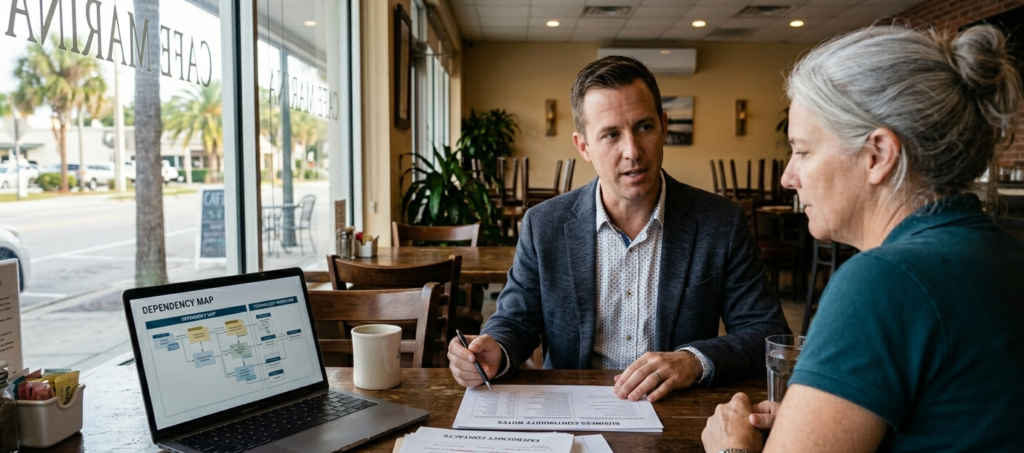
This is exactly why a Business Impact Analysis matters. Ready.gov’s business planning framework is useful because it forces owners to ask which functions become impaired when one system fails.
Many restaurants adopt technology faster than they map dependency.
That is how they become fragile without noticing.
The fallback plan was weaker than we thought
This is where many owners get exposed.
They assume that if one system goes down, the team will just work around it. Sometimes that is true for a few minutes. Sometimes it is not true at all.
The real question is not whether the team can improvise briefly.
The real question is whether the restaurant has a credible fallback when the interruption lasts longer than expected.
If your ordering flow breaks on a busy night, what is the plan?
If a core dashboard becomes unreliable, what decisions are now being made blind?
If staff lose access to a key communication channel, what slows down?
If a system issue affects guests directly, how quickly can the business explain, correct, and recover?
Those are not abstract questions. They are continuity questions.
That is why key questions for reviewing your restaurant insurance plan matters here too. CIS makes the broader point that restaurant owners often assume they are covered or prepared until a changing operation reveals that the current structure no longer matches reality. It specifically warns that new equipment, staffing changes, online ordering, and evolving operations can alter the risk profile of the restaurant.
Tech adoption under pressure creates its own kind of weakness
This is another reason the story works now.
Restaurants are not adopting more tools in a calm environment. They are doing it while dealing with labor strain, margin pressure, rising costs, and guest expectations that keep getting more digital. The National Restaurant Association’s choosing the right AI tools for your restaurant explicitly says restaurants are using AI to address labor shortages, improve efficiency, and manage customer service more effectively. It also says operators should check integration, ease of use, ROI, scalability, and data security before adopting tools.
That advice exists for a reason.
Under pressure, owners tend to focus on upside:
Will this save time?
Will this increase sales?
Will this reduce labor pressure?
Will this improve the guest experience?
Those are valid questions. But if they are the only questions, then the system may be solving one problem while quietly creating another.
A restaurant can become easier to disrupt without becoming obviously unsafe
This is one of the most interesting parts of the issue.
Physical hazards are easy to imagine. Wet floors. Fire. Storms. Broken equipment.
Digital fragility is harder to feel until it bites.
The restaurant may still look polished.
The screens still glow.
The dashboards still impress.
The tools still create a sense of control.
But underneath, the business may have become more exposed to:
- outages
- manipulation
- dependency on vendors
- bad AI output
- staff error amplified by automation
- system failure at peak moments
- reputational damage after digital mistakes
That is why this article should not be treated as anti-tech. It is really about recognizing that modern weakness can be invisible right up until service is disrupted.
This is where cyber liability stops feeling optional
For a lot of restaurant owners, Cyber Liability Insurance still sounds secondary compared with property, liability, or workers’ compensation.
That is getting harder to defend.
CIS already places Cyber Liability Insurance directly inside restaurant and entertainment insurance, which makes sense because modern restaurant operations are no longer purely physical. They are digitally exposed in ways that can create legal, operational, and financial loss all at once.
And NRN’s 2026 warning reinforces that this is not theoretical. Cyber incidents and AI-enabled fraud are now being framed as material restaurant risks, not tech-industry side notes.
Once the business depends on connected systems, cyber protection stops being an optional extra. It becomes part of how the business thinks about continuity.
The smarter move is not less tech. It is more honest review.
This is probably the most useful lesson in the whole piece.
The answer is not to reject technology or romanticize a less connected restaurant. The answer is to stop treating adoption as automatically positive.
The smarter move is to ask:
- What exactly now depends on this system?
- What happens if the tool fails during service?
- What part of the business is now easier to disrupt?
- What errors could AI or automation introduce if staff do not catch them?
- Are we building efficiency, or are we building a brittle stack of dependencies?
That is also why a restaurateur’s intro to AI is such a useful external source here. Even the National Restaurant Association’s own introductory AI material says deployment requires research, planning, staff training, and attention to data privacy and security. It also says AI needs continuous monitoring and may not handle complex or nuanced situations appropriately.
In other words, even pro-tech guidance is warning owners not to confuse adoption with mastery.
The sharper conclusion
So what is the real point of this story?
It is not that technology is a mistake.
It is not that AI is only dangerous.
It is this:
The system that made us smarter also made us fragile because we paid attention to efficiency first and dependency second.
Restaurants are adopting more digital tools because the pressure is real. More operators are using AI-related tools. More functions are moving into connected systems. And cyber incidents and AI-enabled fraud are now part of the real restaurant risk environment.
The smarter move is not to stop building the future.
The smarter move is to review what the future now controls, how the business behaves when the system fails, and whether the insurance and continuity planning have kept up.
Because once a restaurant becomes more digital, it can become more powerful.
And if the owner is careless, it can also become easier to break.