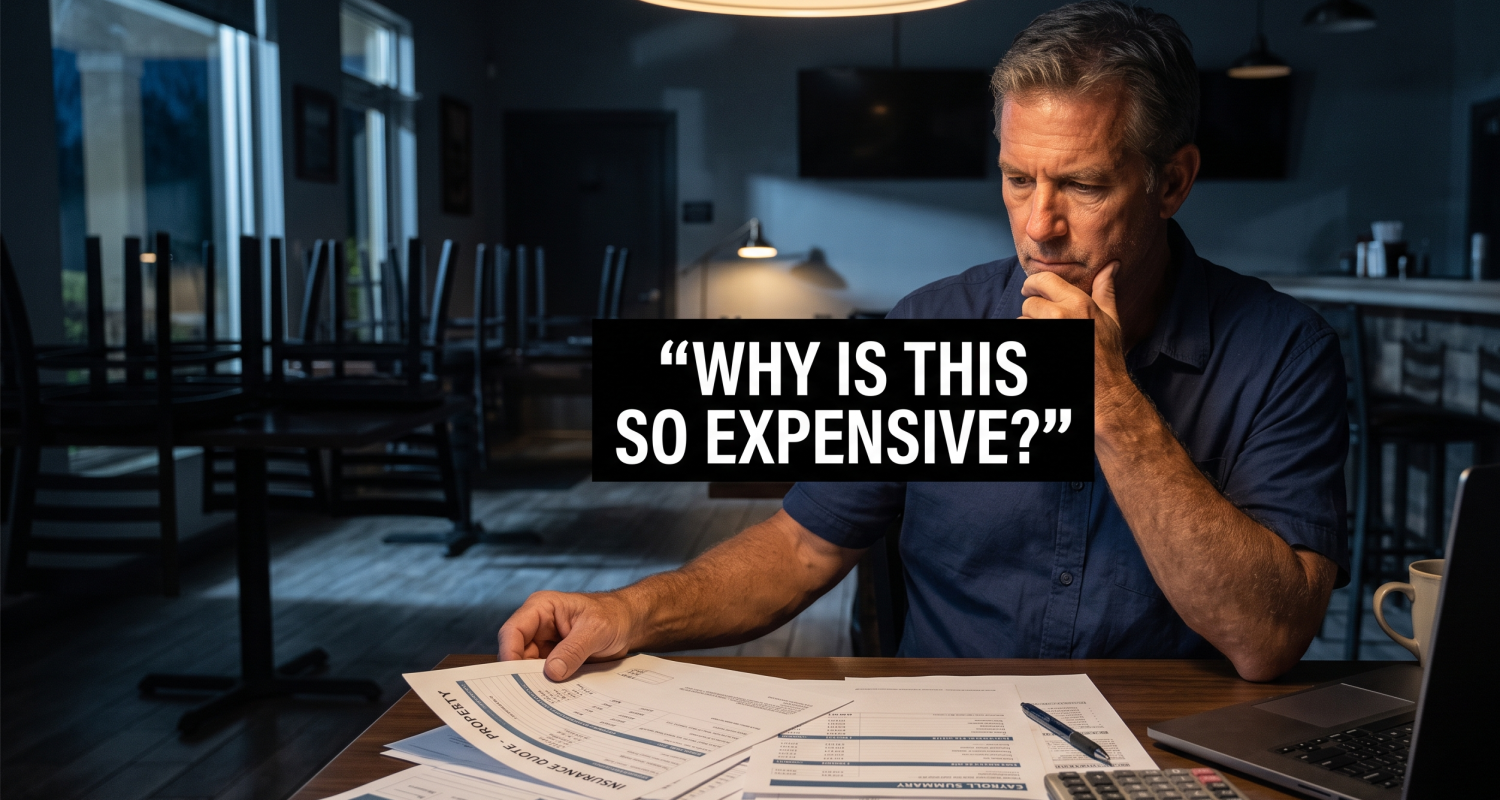
If you want the blunt answer, there is no honest flat price for restaurant insurance in Florida.
A small café with no alcohol, minimal staff, and a modest footprint is not going to price the same way as a full-service restaurant with a bar, delivery exposure, heavy customer traffic, expensive kitchen equipment, and a history of claims. That is why restaurant owners often get frustrated when they ask a simple question — How much does restaurant insurance cost in Florida? — and get an answer that sounds vague.
But the vague answer is often the truthful one.
Restaurant insurance in Florida is not priced like a simple commodity. It is priced according to how exposed, complex, and interruption-sensitive the business actually is. CIS’s recent article why restaurant insurance costs more than many owners expect makes that point directly: restaurant insurance costs more because restaurants face more everyday liability, employee, property, and storm-related exposure than many other small businesses.
That is the real starting point.
And it matters even more in the current operating climate. Persistent Cost Increases and Enduring Demand Will Shape the Restaurant Industry in 2026 says the industry is still under margin pressure, with operators citing food, labor, insurance, energy, and swipe fees as major challenges. In other words, insurance is not rising inside a calm business environment. It is landing on top of several other painful costs at once.
The short answer is that cost depends on risk
That sounds obvious, but most owners still underestimate what “risk” means in restaurant insurance.
It is not only whether the business has ever filed a claim. It is also about how the restaurant operates every day.
Insurance carriers look at questions like:
- how many employees work there
- whether the restaurant serves alcohol
- how much customer traffic the business handles
- whether the restaurant does delivery or uses vehicles
- what the property and equipment values look like
- whether the location is exposed to storms or interruption risk
- how much payroll the business carries
- how claims history looks
- how well the business appears to manage safety and operations
That is why the right answer to “How much does Florida restaurant insurance cost?” is not one number. It is a pricing structure shaped by the kind of restaurant you actually run.
Why restaurant insurance costs more than many owners expect
This is one of the best places to start because it explains the psychology behind the sticker shock.
A lot of owners assume restaurant insurance should be fairly straightforward. They think: we have a location, some staff, customers, equipment, and a business to protect. But why restaurant insurance costs more than many owners expect is actually pretty easy to understand once you stop viewing the restaurant as one category and start viewing it as a stacked-risk operation.
CIS’s article on that exact topic explains that restaurants are expensive to insure because they are customer-facing, employee-intensive, property-heavy, and interruption-sensitive businesses. Customers can get hurt. Employees can get injured. Equipment can fail. Food can spoil. Alcohol can widen liability. Storms can interrupt operations. In Florida, that last part matters even more.
So if the quote feels high, one reason is simple:
the business itself is riskier than it first appears.

Workers’ compensation can push the number up quickly
For many restaurants, one of the biggest cost drivers is labor.
Florida’s Division of Workers’ Compensation says under Coverage Requirements that employers conducting work in the state are required to provide workers’ compensation insurance for employees when they meet the applicable requirements. The Division’s Employer Frequently Asked Questions also says the cost of workers’ compensation insurance is based on three primary factors: the payroll for the business, the type of work performed by the employees, and the individual employer’s claims history.
That matters a lot for restaurants.
Restaurants tend to have:
- more employees than many small businesses
- physically demanding work
- fast-paced environments
- slip, burn, cut, and lifting exposure
- different job roles that may affect payroll classifications
So even before you look at customer claims or storm exposure, labor alone can make restaurant insurance more expensive than many owners expect.
Alcohol service can change the price conversation fast
If the restaurant serves alcohol, the pricing conversation usually changes.
Not every restaurant with beer or wine becomes dramatically expensive to insure. But alcohol does increase exposure, and exposure affects price. A restaurant that sells drinks casually is not being viewed the same way as a concept where cocktails, nightlife traffic, or bar activity are more central to the operation.
That is why liquor liability insurance for restaurants Florida matters not only as a legal or risk topic, but also as a pricing topic. The more important alcohol is to the business, the more likely it is that the policy structure becomes more layered and more expensive.
CIS’s broader restaurant content repeatedly makes the point that restaurants serving alcohol should not treat that risk lightly, because one alcohol-related incident can become financially serious very quickly.
So one honest answer to the cost question is this:
if you serve more alcohol, you may pay more because the exposure is different.
Property and equipment matter more than owners think
Many owners think about insurance in liability terms first, but the physical side of the business matters a lot too.
The more expensive the kitchen, the more specialized the equipment, the more invested the buildout, and the more interruption-sensitive the operation, the more weight property-related coverage carries.
This is one reason restaurant insurance in Florida does not price like office insurance. A restaurant has refrigeration, heat-producing equipment, electrical strain, furniture, fixtures, and business property that can all become expensive if damaged. If the business also depends heavily on that equipment to keep serving, the interruption risk becomes part of the equation too.
That is exactly why business interruption insurance: a must for restaurants is such a relevant internal article here. The point of that piece is that when a restaurant is forced to slow down or close after a covered event, the damage is not only physical. It is financial and operational too.
And the more sensitive the operation is to interruption, the more seriously insurers will view the exposure.
Florida itself affects the cost
A restaurant in Florida is not being priced in the same environment as a restaurant in a calmer, lower-exposure state.
Florida carries specific pressure around storm exposure, interruption risk, weather damage, and the kinds of operational disruptions that can hit a restaurant harder than owners first assume. CIS’s recent content on rising restaurant insurance costs in Florida makes that point directly: restaurants in Florida face an operating environment where weather and downtime are not rare edge cases. They are part of the business reality.
That does not mean every Florida restaurant pays the same. But it does mean Florida adds context to the quote.
If two restaurants are otherwise similar, the Florida one may still feel heavier from an insurance perspective simply because the operating environment itself is more demanding.

Claims history and safety discipline influence cost too
This is another part owners often skip over.
An insurance quote is not only pricing the restaurant category. It is also pricing the specific business.
That means your own history matters. Claims history matters. Safety discipline matters. How well the business is run matters. Review habits matter. Restaurants that let hazards pile up, fail to address recurring risks, or operate with weak control over basic exposures are usually not in the same position as restaurants that manage those issues more proactively.
That is one reason key questions for reviewing your restaurant insurance plan matters so much to the cost conversation. CIS’s article says restaurant owners often assume their policy is still fine even after staffing, equipment, menu, delivery, or operational changes have altered the risk profile. It also positions regular review as one of the smartest ways to avoid paying for the wrong structure or missing opportunities to improve it.
So if an owner wants to lower cost over time, one of the smartest moves is not only “shop harder.” It is “operate in a way that gives the quote room to improve.”
Compare restaurant insurance quotes Florida carefully, not emotionally
This is where many owners make the wrong move.
They get two or three quotes, see different totals, and instinctively move toward the lowest number. That is understandable, but it is also where many bad insurance decisions begin.
The better way to compare restaurant insurance quotes Florida is to compare structure, not only price.
That means asking:
- What coverages are included?
- What limits are included?
- What deductibles are included?
- Is alcohol addressed properly?
- Is interruption addressed properly?
- Is the quote reacting to the actual operation, or is it a generic package?
- Is cyber or equipment exposure being ignored just to make the number look better?
This is one reason the CIS article about sushi and tapas restaurants is so useful. It argues that owners should compare restaurant insurance quotes Florida with attention to the actual risk profile of the concept, not just the cheapest number on paper.
That is a better mindset for any restaurant owner:
the cheapest quote is not always the lowest-cost decision.
Low-cost restaurant insurance plans in Florida do exist, but “low-cost” should not mean weak
This is another place where owners need a cleaner definition.
Yes, low-cost restaurant insurance plans in Florida exist. But the useful version of “low-cost” is not “thin and risky.” It is “cost-efficient relative to the actual business.”
CIS’s key questions for reviewing your restaurant insurance plan talks directly about low-cost restaurant insurance plans in Florida and frames them as plans that grow with the business while protecting operations and the bottom line. In other words, the goal is not to underinsure yourself into a future disaster. The goal is to build a structure that is affordable without becoming dangerously incomplete.
That is an important distinction.
A restaurant owner can absolutely pursue lower cost.
They just should not pursue it blindly.
Bundling can help lower the number
This is one of the clearest practical strategies.
CIS’s article affordable BBQ restaurant insurance: cut costs, not coverage says that bundling essential coverages into a Business Owners Policy can sometimes reduce premiums by 15–20% compared with buying those policies separately. It presents bundling as one of the most effective ways to lower insurance costs without stripping away important protection.
That does not mean every restaurant will get the same result. But it does mean the owner should not assume the only way to lower price is to remove protection. Sometimes the better move is to organize coverage more intelligently.
This is one reason shopping and review matter so much. The structure can change the number.
The most honest answer is that cost reflects the restaurant you built
This is probably the sharpest way to say it.
Restaurant insurance cost in Florida reflects the restaurant you built.
A quiet café with no alcohol, low payroll, modest property values, and strong safety habits should not price like a late-night concept with high traffic, more employees, delivery exposure, expensive equipment, and a claims history. The number is not random. It is the result of how the business actually operates.
That is why some owners feel the quote is unfair. What they are really reacting to is not only the premium. They are reacting to what the premium reveals about how exposed the business looks from an insurer’s point of view.
That is uncomfortable, but it is useful.
The sharper conclusion
So how much does Florida restaurant insurance cost?
There is no honest universal number. The cost depends on payroll, employee duties, claims history, alcohol service, customer traffic, property and equipment values, delivery exposure, interruption sensitivity, and the broader Florida risk environment. Florida’s own Employer Frequently Asked Questions says workers’ compensation cost alone is influenced by the payroll for the business, the type of work performed by the employees, and the individual employer’s claims history. CIS’s restaurant content also makes clear that restaurants cost more to insure because the business itself is layered and exposed in multiple ways.
That is the sober answer.
Not because insurers enjoy making things complicated.
But because restaurants are complicated.
The better goal is not to hunt for one magic cheap number.
It is to understand what is driving your price, build the right structure, and then improve the variables you actually control.
Because the cheapest quote is not always the smartest one.
And the smartest one is usually the one that still makes sense when the business hits a hard month.