Restaurant Insurance
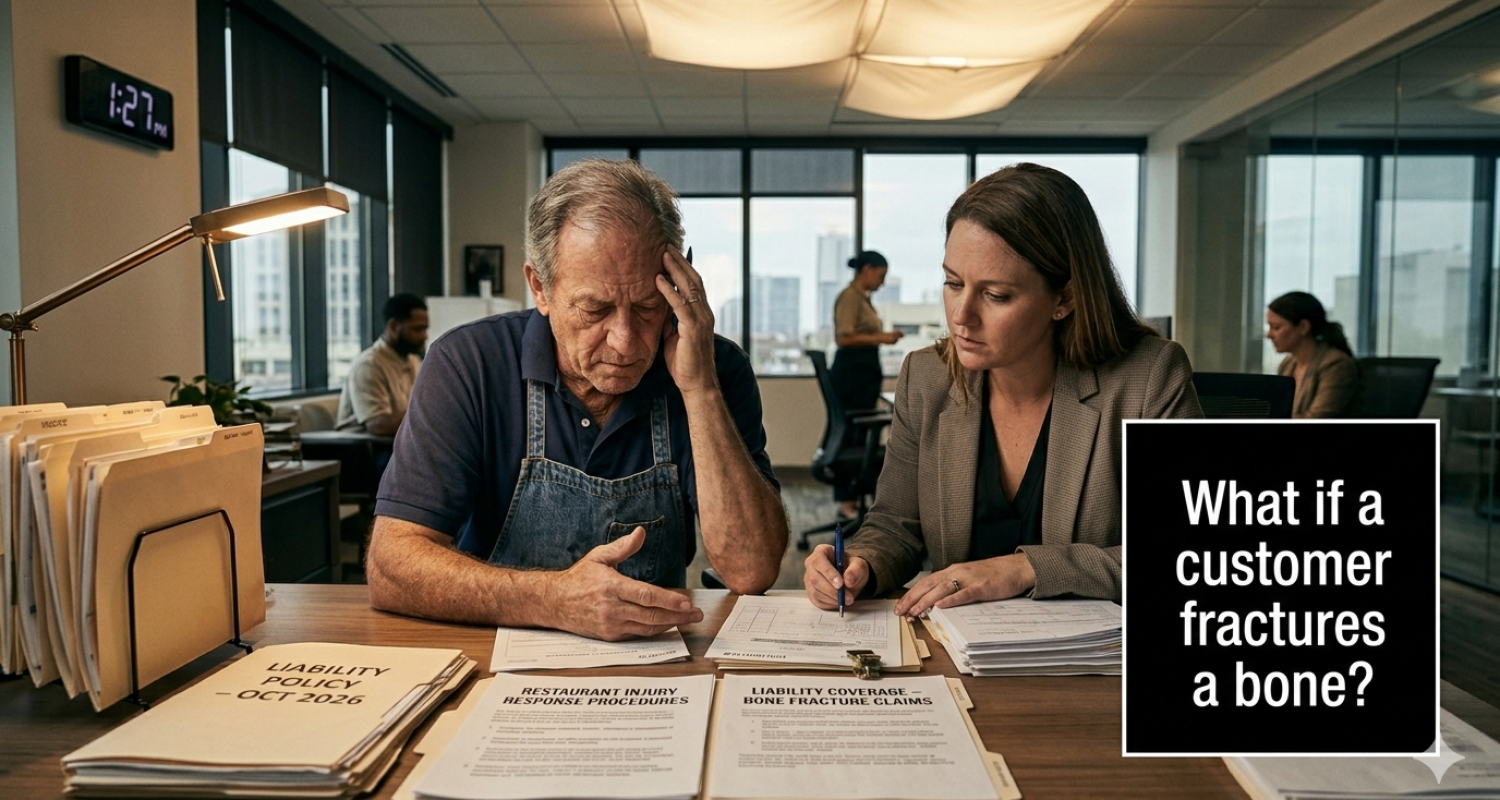
If a customer falls and fractures a bone at your restaurant in Florida, the situation can become serious in a matter of seconds. What begins as an accident on a wet floor, uneven surface, doorway, patio, or crowded walkway can quickly become a medical event, an evidence problem, a liability issue, and potentially a claim or lawsuit. That is why the first response matters so much. Restaurant owners do not need panic in that moment. They need a clear process. The U.S. Small Business Administration notes that business insurance is meant to protect companies from unexpected costs tied to accidents, natural disasters, and lawsuits, and this is exactly the kind of incident where that principle becomes real.
Under Florida law, restaurants and other business establishments owe duties to people who enter as invited customers. Florida’s premises-liability statutes define an “invitation” and address liability issues in business settings, including special rules for slip-and-fall cases involving transitory foreign substances. In those cases, the injured person must prove the business had actual or constructive knowledge of the dangerous condition and should have taken action to correct it. That does not mean restaurant owners should respond defensively. It means they should respond carefully, professionally, and in a way that preserves facts.
This article walks through the practical step-by-step response a Florida restaurant should follow if a customer falls and appears to suffer a fracture. It is not a substitute for legal advice on a specific claim, but it is a strong operational framework for reducing confusion, protecting the injured guest, and protecting the business.
Step 1: Get Immediate Medical Help and Do Not Minimize the Injury
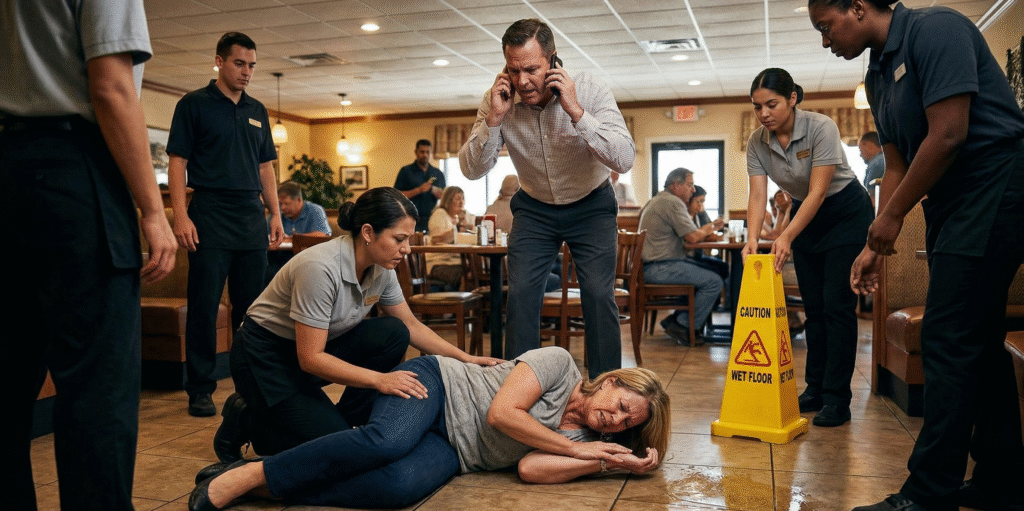
If a customer falls and may have fractured a bone, the first priority is medical response, not liability strategy. Staff should help secure the area, avoid moving the injured person unnecessarily unless there is an immediate safety threat, and call 911 if the injury appears serious, if the person cannot stand, if there is visible deformity, intense pain, bleeding, head impact, loss of consciousness, or any uncertainty about the severity. A fracture is not something restaurant staff should try to “walk off” or casually assess on their own.
This sounds obvious, but many businesses create problems by reacting too casually in the first minutes. Staff may say things like “you’re probably okay,” “it’s not that bad,” or “let’s just get you up.” That is a mistake. If the person truly has a fracture, moving them incorrectly or minimizing the injury can make the situation worse medically and legally. The safest response is calm, serious, and practical.
At the same time, the restaurant should keep the surrounding area controlled. Staff should redirect customer traffic, prevent crowding, and eliminate any ongoing hazard if it can be done without disturbing the incident scene more than necessary.
Step 2: Secure the Scene Immediately
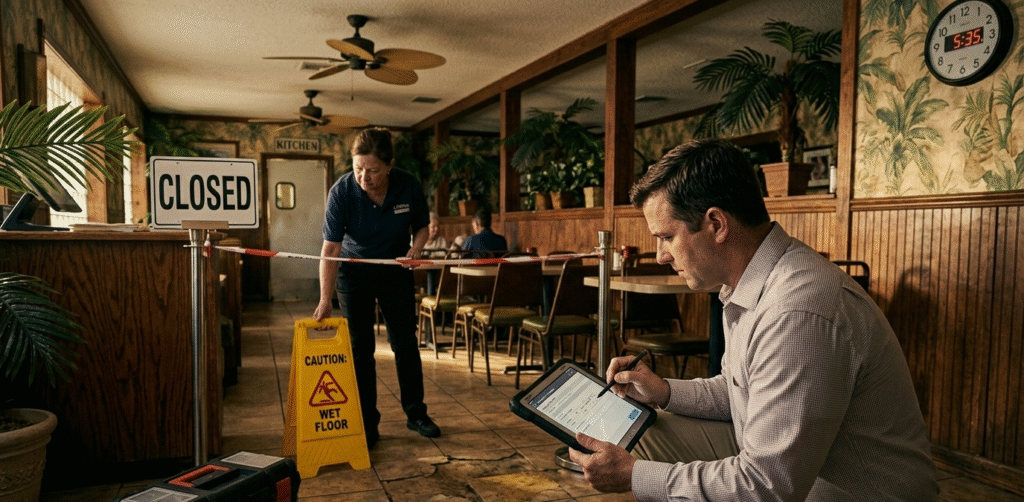
Once emergency response is underway, the next priority is securing the scene. If the fall involved a wet floor, spilled liquid, damaged flooring, debris, poor lighting, or another visible condition, that area needs to be controlled right away. OSHA’s guidance on slips, trips, and falls emphasizes keeping floors clean and dry and keeping aisles and passageways clear and in good repair. OSHA also specifically references warning signs for wet-floor areas in restaurant-related safety guidance. While OSHA is focused on workplace safety, those same physical conditions are highly relevant when a customer is injured.
Securing the scene means:
- stopping other guests from walking through the area
- placing warning signs if appropriate
- preserving the condition as accurately as possible for documentation
- preventing staff from casually cleaning or rearranging the scene before management has documented it
This part matters because many claims later turn on whether the hazard existed, whether it was visible, whether warning signs were present, and how long the condition had likely been there. If the scene is altered immediately without documentation, the restaurant loses clarity.
Step 3: Notify the Manager or Person in Charge Right Away
The manager on duty, owner, or designated person in charge should be notified immediately. Florida’s Division of Hotels and Restaurants places clear responsibility on operators of public food service establishments for safeguarding public health, safety, and welfare through regulated operations and inspection oversight. In practice, that means restaurants should not leave serious customer incidents to untrained front-line improvisation.
A serious fall involving a possible fracture should not stay at the level of “staff are handling it.” Management needs to take control of:
- witness awareness
- documentation
- communication
- preservation of video and records
- later contact with insurance or counsel if needed
If the restaurant does not have a clear escalation process for injury incidents, it should create one.
Step 4: Show Empathy, But Do Not Admit Fault on the Spot
Restaurant owners and managers should respond with empathy and professionalism. A customer who is in pain and frightened does not need coldness, and a robotic response can make a bad situation feel worse. It is completely appropriate to say:
- “We’re calling for medical help.”
- “We’re sorry this happened.”
- “Please stay still while help is on the way.”
- “We’re going to document what happened and make sure the area is controlled.”
What staff should avoid is making legal conclusions in the moment.
That means avoiding statements like:
- “This was our fault.”
- “We knew this floor was dangerous.”
- “Don’t worry, our insurance will pay.”
- “This happens all the time.”
A fracture incident is emotionally intense, and careless statements made under stress can complicate claims later. The goal is compassion without speculation.
Step 5: Document the Incident Before the Facts Start Fading
Documentation should begin as soon as the immediate medical situation is stable enough for management to act. This is one of the most important steps in the entire process.
The restaurant should document:
- the exact time of the incident
- the exact location of the fall
- what staff observed directly
- the apparent condition of the floor or area
- weather conditions if relevant
- whether warning signs were present
- names of employees on duty
- names of witnesses willing to provide them
- whether emergency services were called
- whether the customer declined or accepted medical transport
Photos and video matter. If there is a spill, damaged flooring, tracked-in rainwater, poor lighting, or a physical obstruction, photograph it from multiple angles before the condition changes further. If there are surveillance cameras, preserve the footage immediately. Do not assume it will still be there later.
This documentation becomes especially important in Florida slip-and-fall cases because Florida Statute 768.0755 requires the injured person to prove the business had actual or constructive knowledge of a transitory foreign substance. Constructive knowledge may be inferred from circumstances showing the condition existed long enough that the business should have known about it, or that it occurred with regularity and was therefore foreseeable. Precise documentation helps the business understand what actually happened and respond intelligently.
Step 6: Collect Witness Information While People Are Still Available
Witnesses disappear quickly in restaurant environments. Customers leave. Staff rotate. Memories fade almost immediately.
If there are witnesses, management should politely obtain:
- full name
- phone number or email
- brief summary of what they saw
Do not coach them. Do not push them to take sides. Just preserve the fact that they were present and what they observed.
This matters because in customer injury claims, witness accounts can shape whether the event later looks like:
- a sudden unpredictable accident
- a hazard no one could have seen
- a hazard employees had ignored
- a condition customers had already noticed
Even if the witness seems unimportant in the moment, their observation may later become highly relevant.
Step 7: Preserve Cleaning Logs, Inspection Logs, and Shift Records
One of the biggest mistakes restaurants make after an injury is focusing only on the visible scene and forgetting the internal records that may become just as important.
The business should preserve:
- floor inspection or cleaning logs
- opening or side-work checklists
- bathroom check logs if relevant
- maintenance records for flooring or lighting
- employee schedules
- training records on spill response or safety procedures
- weather-related opening procedures if the event involved rain or tracked-in water
These records help answer the kinds of questions that often arise later:
- Were staff checking the area regularly?
- Was the restaurant following its own procedures?
- Had there been prior issues in that location?
- Was the hazard known or recurring?
If the records exist, preserve them. Do not rewrite them after the incident. Do not backfill them. Just preserve what was in place at the time.
Step 8: Complete a Formal Incident Report the Same Day
If the restaurant has an incident report form, use it. If it does not, it should create one immediately for future use.
The report should include:
- date and time
- location
- names of staff involved
- facts observed directly
- actions taken
- emergency response details
- witness information
- photographs/video preserved
- condition of area at time of incident
The report should be factual, not argumentative. It should avoid speculation and legal conclusions. Do not write things like “customer was careless” unless that is an exact observed fact supported by specifics, and even then it should be written carefully.
A good report sounds like this:
“Customer fell near entrance at approximately 7:18 PM. Floor appeared wet from tracked-in rainwater. One wet-floor sign was present approximately six feet from entrance. Manager arrived at scene at approximately 7:20 PM. EMS called.”
A bad report sounds like this:
“Customer obviously exaggerated and probably wanted money.”
The second type of report can become a problem later.
Step 9: Report the Incident to the Insurance Carrier Promptly
After the immediate crisis and documentation steps are handled, the restaurant should report the incident promptly through the appropriate insurance channels. The SBA’s insurance guidance is clear that accidents and lawsuits can create unexpected costs significant enough to threaten a business, which is exactly why timely notice matters.
For restaurants, this is one reason commercial liability coverage is so important. A customer fracture claim can involve medical allegations, attorney involvement, and potentially substantial damages. Delayed reporting can create unnecessary complications, and owners should not assume that “we’ll wait to see if they call us back” is the best strategy.
The restaurant should provide the insurer with:
- incident report
- photos
- witness information
- surveillance footage preservation notice
- any communications already received from the customer or their representative
Do not send edited narratives. Send organized facts.
Step 10: Do Not Destroy or Overwrite Surveillance Footage
This deserves its own step because it is so often mishandled.
If the restaurant has surveillance footage that captured:
- the fall
- the area before the fall
- employee movement before the fall
- the customer’s path into the restaurant
that footage should be preserved immediately.
Many systems overwrite footage automatically after a short period. If management waits too long, crucial video can disappear. That can become a serious problem whether the video helps the restaurant or hurts it. The goal is not selective preservation. The goal is factual preservation.
If there is any chance of a serious claim, preserve the footage early and carefully.
Step 11: Review Whether the Incident Involved a “Transitory Foreign Substance”
In Florida, slip-and-fall cases involving a transitory foreign substance in a business establishment follow a specific statutory framework. Florida Statute 768.0755 requires proof that the business had actual or constructive knowledge of the dangerous condition and should have acted to remedy it. Constructive knowledge may be shown through evidence that the condition existed long enough that the business should have known about it, or that it happened regularly enough to be foreseeable.
This means the restaurant should review whether the fall involved something like:
- spilled liquid
- tracked-in rainwater
- dropped food
- grease
- other temporary surface contamination
That review should be internal and factual. The point is to understand what kind of condition is being alleged so the restaurant can respond intelligently through the right channels.
Step 12: Evaluate Whether the Area Had a Known Pattern of Risk
Some areas in restaurants predict injuries more than others.
Examples include:
- entryways during rain
- service stations
- drink refill areas
- bathrooms
- transitions between indoor and outdoor seating
- uneven patios or stairs
- high-traffic hostess areas
After a fracture incident, the restaurant should ask an uncomfortable but necessary question: was this area already known to be risky?
If the answer is yes, that does not automatically mean the restaurant is liable. But it does mean the business should move quickly to address the condition and tighten procedures. A known recurring hazard that is left under-managed creates exactly the kind of pattern that can make later claims harder to defend.
Step 13: Do Not Contact the Injured Person Casually After the Incident
Once the incident has happened, the restaurant should be careful about follow-up communication.
A well-intentioned owner may want to call and “check in,” but unstructured conversations can create confusion or admissions that are not helpful later. If follow-up occurs, it should be coordinated appropriately and handled with professionalism.
What the restaurant should not do is:
- pressure the person not to file a claim
- offer side payments informally
- ask them to say they were at fault
- argue about what happened
- engage emotionally over text or social media
This is where many businesses turn a controlled incident into a messy one.
Step 14: Correct the Hazard Immediately After Documentation
Once the scene is documented appropriately, the hazard itself must be corrected.
That might mean:
- cleaning and drying the area
- replacing damaged flooring
- improving drainage or mats
- adding or relocating warning signs
- adjusting inspection frequency
- improving lighting
- changing housekeeping or service procedures
OSHA’s restaurant and food-service safety materials repeatedly emphasize practical controls such as keeping walking surfaces clean, dry, and unobstructed. Those are not abstract ideas. They are the exact kinds of operational changes that reduce repeat incidents.
Do not wait for the claim to be resolved before making the area safer.
Step 15: Treat the Incident as a Management Lesson, Not Just a Claim
A serious customer fall should trigger a broader management review.
The restaurant should ask:
- Did staff respond correctly?
- Did anyone know the area was risky already?
- Were warning signs enough?
- Did inspection routines fail?
- Was weather preparation weak?
- Was the incident captured clearly in documentation?
- Do we need stronger insurance review?
This is where restaurant and entertainment insurance becomes more than a policy category. It becomes part of a broader protection strategy for a business that welcomes the public every day. A fracture claim is exactly the kind of event that reminds owners that restaurants do not need generic protection. They need protection built around real hospitality risk.
Why This Matters So Much in Florida
Florida restaurants are especially exposed to customer fall risk because of weather, traffic, and operating conditions. Rain, storm seasons, humidity, patio transitions, and heavy customer flow all increase the likelihood of slip-and-fall incidents if procedures are not disciplined.
At the same time, Florida’s restaurant regulatory environment makes clear that public food service establishments operate under state oversight focused on public health, safety, and welfare. That means owners should think about these incidents not only as private customer problems, but as part of the broader responsibility of operating a safe public-facing establishment.
Final Thoughts: The Goal Is a Controlled Response, Not a Perfect Outcome
If a customer falls and fractures a bone at your restaurant in Florida, you cannot rewind the event. But you can control the response.
The best response is:
- medically serious
- calm
- well documented
- professionally managed
- evidence-preserving
- insurance-aware
- focused on correcting the hazard quickly
That does not guarantee there will be no claim. It does put the restaurant in a much stronger position than a chaotic, emotional, undocumented response would.
In practical terms, the owner’s job in that moment is not to debate fault on the floor. It is to protect the injured person, protect the facts, protect the scene, and protect the business by doing the next right thing in the right order.
That is what a strong Florida restaurant response looks like.